Showing posts with label Frankenstein. Show all posts

Wednesday, December 29, 2010

How America Lost its Soul

by Len Hart, The Existentialist Cowboy

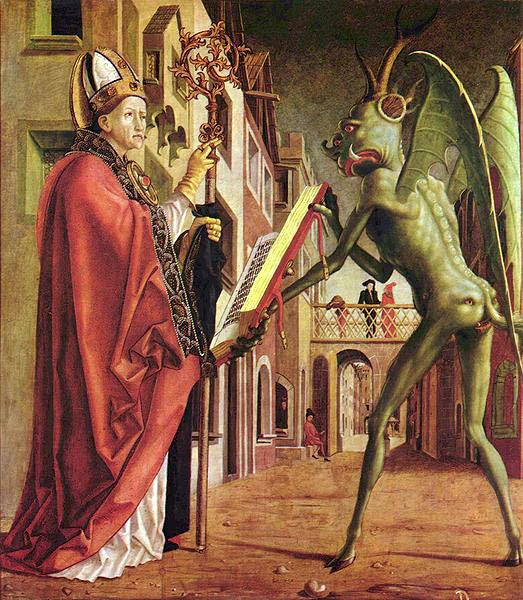
Literature is characterized by recurring themes. On a short list of archetypal stories is the 'pact' which some are said to have entered into with 'Satan'. In many variations, a protagonist agrees to exchange his soul for worldly or temporary gain. As a 'cultural motif', it is most often associated with or exemplified by the German legend of Faust or Mephistopheles.

It is significant that Faust or Faustus means 'lucky' --or 'auspicious' in the original Latin. It is, I'm sure, merely coincidental that Larry Silverstein who is the most obvious, the most notable beneficiary of 911, is called 'Lucky' Larry! In Latin --Faust!

In Goethe's retelling of this archetypal legend, Faust is unhappy, unsatisfied though he is a highly successful scholar. Mephistopheles makes him a 'bargain' that he cannot refuse. Faust agrees to exchange his soul for 'unlimited knowledge' and worldly pleasures. This motif is archetypal and not unique to Western or Christian traditions. It is found, I am told, in almost all cultures throughout history.

To be expected, the western versions of this legend are heavily influenced by traditional Christian beliefs in witchcraft. The pact is between a person and Satan or any other demon; the person offers his or her soul in exchange for diabolical favors, most often material, monetary or sexual but may include youth, knowledge, wealth, or power in various forms and proportions. It was also believed that some persons entered into such a pact in exchange for nothing; it was a sign of recognizing the devil (Satan) as master.
"I told the invited scientists who the Committee was, the Interim Committee, what it was established for, and then I switched over and told them what we wanted of them, the invited scientists; first, to congratulate and thank them for what they have done and then to get them started in talking and questioning. It was a little slow sledding at first but I think I got some wrinkles out of their heads in regard to my own attitude and that of the Army towards this new project. I told them that we did not regard it as a new weapon merely but as a revolutionary change in the relations of man to the universe and that we wanted to take advantage of this; that the project might even mean the doom of civilization or it might mean the perfection of civilization; that it might be a Frankenstein which would eat us up or it might be a project 'by which the peace of the world would be helped in becoming secure'. Well after a while the talk went pretty well. I had Marshall in and during a time when I had to be absent to go over to the White House he took a vigorous hand in the discussion and I think impressed himself very much upon them. I think we made an impression upon the scientists that we were looking at this like statesmen and not like merely soldiers anxious to win the war at any cost. On the other hand, they were a fine lot of men as can be seen from their records. Dr. Fermi, Dr. Lawrence, and Dr. Compton were all Nobel prize winners; and Dr. Oppenheimer, though not a Nobel prize winner, was really one of the best of the lot."

--HIROSHIMA: HENRY STIMSON'S DIARY AND PAPERS: Part 5, May 31, 1945 - June 6, 1945
The development of nuclear weapons is often said to be 'Faustian'. Indeed, for a few post war years, the United States, as the sole possessor of atomic power, ruled the world. Even before the bomb was dropped there were doubts about the wisdom of unleashing the atomic genie. It was Physicist Robert Oppenheimer, supervising the U.S. 'Manhattan Project' who quoted the Bhagavad-Gita:
"...now I am become Death [Shiva], the destroyer of worlds..."
Another version differs only slightly:
If the radiance of a thousand suns
Were to burst at once into the sky
That would be like the splendor of the Mighty one...
I am become Death,
The shatterer of Worlds.
Forbidden Planet of 1956 is a classic Sci-Fi tour de force staring Leslie Nielson, Walter Pidgeon, and Anne Francis. It holds up surprisingly well against Star Wars of the 1970's and even the most recent digital entries.

The story of Dr. Morbius, re-discovering the technological marvels of a lost race of Krell on the distant planet Altair, is updated Shakespeare: The Tempest. And while Forbidden Planet excels in special effects, it's enduring fascination is found in a parable: technology vs its inventor, the monster vs Dr. Frankenstein, in fact any one at war with the enemy of his/her own making.

Forbidden Planet lays bare the dark side of human kind, a forbidding gestalt of uncontrollable urges, the monster from the ID! Just as Lord of the Rings depicts the absolute corruption of absolute power, Forbidden Planet confronts us with a question we would rather not answer: what are we to do with the physical manifestations of our inmost monsters?

Is "Terrorism" the Monster From the ID?

FBI statistics published by the Brookings Institution repudiate the political exploitation of terror by the recent Bush administration, the right wing in general. The FBI's own statistics indicate that while Ronald Reagan most vociferously waged his famous "War on Terrorism", terrorist attacks against the United States actually increased. There were three times as many terrorist attacks during the Reagan years as were the case under Clinton. Yet --Clinton was criticized for not having waged such a 'war on terrorism'. Either the American right wing has not bothered to check the numbers or it has checked them and lies about them. In retrospect, only the wealthy, elite right wing constituency has ever benefited in any way by various 'wars' on terrorism. The rest of us are cannon fodder. The right wing consisting of powerful lobbies and military contractors has made a Faustian bargain. The U.S. is akin to Morbius of Forbidden Planet --too late do we recognize that the only demons that howl are of our own making.

In the United States, if not everywhere, it is the ruling elite that, like Faust, made the bargain. Scrooge was wrong and so is the contemporary right wing. Scrooge was wrong because the terms 'rich' and 'poor' are subjective and often the 'poor class' is the result of elitist greed. The 'monster' that is thus created is not merely the statistical imbalance between right and poor but the insidious economic inefficiencies that result. For example, in the U.S. just one percent of the population owns more than some 95 percent of the rest of the population combined. A inequitable society is an inefficient society. The U.S., for example, seems always to plunge into recession/depression during GOP regimes in which it is also true that the very, very rich have gotten even richer.

By way of influence, lobbies and campaign contributions, et al, the U.S. elite controls the apparatus of government. Naturally, this 'ruling elite' favors economic policies which enrich them to the detriment and/or impoverishment of everyone else. This is the reductio ad absurdum of the Scrooge (Herbert Spencer) position which maintains, wrongly and fallaciously, that the rich are rich because they are smarter and better.


Robert Oppenheimer on the Manhattan Project


Friday, January 23, 2009

Mary Shelley's Worst Nightmare

by Len Hart, The Existentialist Cowboy

The products of technological advance are, themselves, neutral. What we do with rocks, sharp sticks or nukes, however, is a moral issue. The emergence of 'artificial intelligence' carries implications for warfare --'automated nukes' and 'robotized warfare'. The word 'Frankenstein' has come to mean 'monsters of our own creation', monsters beyond our control.

Until Isaac Asimov's seminal "I, Robot", most robotic oriented sci-fi could be summed up in a sentence: Robots were created and destroyed their creator.

Some Sci-fi authors imagined an advanced race taming both its own destructive impulses as well as those of its robots. The fifties classic, The Day the Earth Stood Still, is premised upon the use of robotic power to impose peace. [See: Sci-Noir: The Day the Earth Stood Still (Again!)]

Asimov attempted to 'create' a 'noble' robot that could not harm a human being. Thus was born in his 1942 short story "Runaround", Asimov's 'Three Laws of Robotics'
  1. A robot may not injure a human being or, through inaction, allow a human being to come to harm.
  2. A robot must obey orders given to it by human beings, except where such orders would conflict with the First Law.
  3. A robot must protect its own existence as long as such protection does not conflict with the First or Second Law.
The very word 'Frankenstein' has come to mean 'monsters of our own creation' but more generally, monsters beyond our control. 'Frankenstein' has come to symbolize the Faustian bargain made by man with his own technology. The '50's Sci-Fi classic, Forbidden Planet, echoed Shakespeare's The Tempest which, likewise, dealt with the same theme. [See: Monsters From the ID]

The film, Rowing with the Wind, is set near Geneva, Switzerland in the summer of 1816. It was then that Lord Byron challenged Percy Shelley, Mary Shelley, and her stepsister Claire to write the ultimate horror story. Mary Shelley's response to the challenge made literary history: Frankenstein.
It was a brilliant piece of work for someone so young. But it came out of a hotbed of post-industrial-revolution intellectuals, steeped in a rising concern over what science and industrialization were doing to the world.

Her young protagonist, Victor Frankenstein, tells us early on that

My reluctant steps led me to M. Krempe, professor of natural philosophy, an uncouth man, but deeply imbued in the secrets of his science.
And under Krempe's instruction, Frankenstein's Faustian quest for knowledge takes him to the terrifying secret of life. His product, the monster, is more articulate, more intelligent, and more able to feel pain than his human maker. The monster produced by Frankenstein's intelligence and creative drive had Frankenstein's intelligence and sensibilities, but in a kind of grotesque parody.

--Dr. John Lienhard, Frankenstein
In Rowing with the Wind, Mary Shelley fears that the 'monster' of her fertile imagination has become, in a sense, real as she witnesses a series of tragedies befalling the people around her.

The 'monster' of this film is not the one of her famous story --Frankenstein. The 'monster' of this film is seen throughout but never actively causing deaths. It is the vehicle with which the film explores the four disparate personalities, their intellects, their eccentricities, their fears and passions, their 'monsters from the Id'.

The film takes place near Geneva, where Byron had made his challenge, where Mary Shelley birthed her 'monster'. The photography is scenic and colorful; the costumes recall the era; the dialogue is witty and of the period.

Unless there is a dramatic and universal change of attitudes, mankind will fall victim to its own robotic weapons of mass destruction. Already, sophisticated 'robots' have been built and tested. A 'second generation' will make Robocop look antique. Future generations may utilize exotic or nuclear power. They may fly, see through buildings, target victims with a panoply of high-tech detection technologies not dreamed of today. This is truly 'Frankenstein' beyond Mary Shelley's worst nightmares.
Until he learns these things, he will write as though he stood among and watched the end of man. I decline to accept the end of man. It is easy enough to say that man is immortal because he will endure: that when the last ding-dong of doom has clanged and faded from the last worthless rock hanging tideless in the last red and dying evening, that even then there will still be one more sound: that of his puny inexhaustible voice, still talking.

I refuse to accept this. I believe that man will not merely endure: he will prevail. He is immortal, not because he alone among creatures has an inexhaustible voice, but because he has a soul, a spirit capable of compassion and sacrifice and endurance. The poet's, the writer's, duty is to write about these things. It is his privilege to help man endure by lifting his heart, by reminding him of the courage and honor and hope and pride and compassion and pity and sacrifice which have been the glory of his past. The poet's voice need not merely be the record of man, it can be one of the props, the pillars to help him endure and prevail.

--William Faulkner, Nobel Prize Acceptance Speech, 1950


Saturday, July 26, 2008

The Enemy is Us!

The very word 'Frankenstein' has come to mean 'monsters of our own creation' but more generally, monsters beyond our control. 'Frankenstein' has come to symbolize the Faustian bargain made by man with his own technology. The '50's Sci-Fi classic, Forbidden Planet, echoed Shakespeare's The Tempest which, likewise, dealt with the same theme. [See: Monsters From the ID]

The world is now threatened with several forms of extinction:

  • a slow demise from the disregard with which we have treated our environment;
  • a descent into either lawlessness or fascism for our neglect of the rule of law;
  • the prospect of a quick but not painless end from nuclear annihilation.
These monsters threaten to destroy us utterly. These monsters are our own creations. These monsters are the by-products of the Faustian bargain mankind has made with the universe. These monsters are 'Frankensteins' of our creation. Or, as Pogo might have put it: 'We have seen the enemy and it is us!"

The worst crimes were dared by few, practiced by more, but tolerated by all

--Tacitus, Annals (writing of the decline of Rome)

Over the course of time, Frankenstein's monster has usurped the very name of his creator, Victor Frankenstein, the precocious student of natural philosophy from Geneva, where Mary Shelley was living with two gifted poets, her husband, Percy, and George Gordon, Lord Byron, when she conceived the strange Gothic tale. A period of bad weather in Switzerland bred a compact between Byron, Percy, and Mary, that while at the Villa Diodati, each should write the kind of story the trio were so enjoying reading.

Numerous twentieth-century films attest to the story's durability, perhaps because of what science has become in western society over the past two centuries. The subtitle, "The Modern Prometheus," suggests the mythic dimensions of the three-fold tale.

The author, incredibly not quite nineteen at the time of composition (and, moreover, a teenaged mother), draws a correspondence between young Frankenstein's hope of scientific glory prompting him to manufacture a monster and God's creating the archangel who would become the rebel Satan. God's making of man is also at issue in the epigraph that Mary Shelley takes from Milton's Christian epic of creation and original sin, Paradise Lost.

--Mary Shelley's "Frankenstein" (1818)

Published Articles

Subscribe


GoogleYahoo!AOLBloglines


Add to Technorati Favorites

, , ,

Spread the word

yahoo icerocket pubsub newsvine