Saturday, December 01, 2007

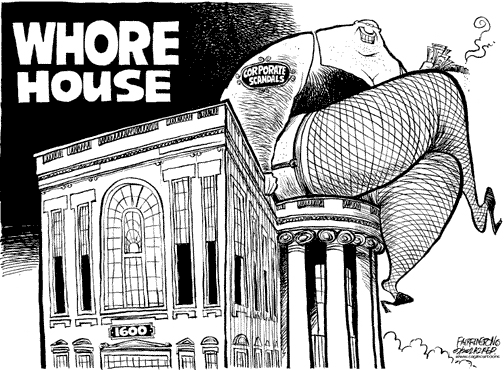
Why the GOP lies about the economy

by Len Hart, The Existentialist Cowboy

The United States has never been so polarized and never has the polarization made less sense. Never has it been more virulent. But --what if I were to tell you that Ronald Reagan was the biggest spending liberal of them all and John Maynard Keynes --reviled by Reagan-heads --was a conservative? What if I told you that Ronald Reagan failed when he actually did what he said he would do and succeeded when he did what he said he wouldn't?

"Whore House" politics debases the language to facilitate their lies. They lie in order to cover up the the cloaked pay off. What passes for debate is irrational and needlessly vehement. It's all a smokescreen. The terms "liberal" and "conservative", for example, are all but meaningless in the world apres-Bush. The meaning of both terms are entirely different now than in the 19th Century, in fact, both terms are used differently in Europe than in the US.

For example, British economist John Maynard Keynes is habitually scorned by right-wingers. Not surprisingly, his brand of economics is called "liberal" if his name comes up at all. I daresay --most conservatives have probably never heard of him. Of those who ave heard his name, few understand him. Yet, Keynes took issue with Karl Marx on a key point: "I don't want a social revolution". Keynes, however, called poverty a "...dysfunctional threat" to a capitalist system which he favored.

I call favoring capitalism, "conservative". Nevertheless, that Keynes denounced "poverty" is enough to earn the enmity of modern conservatives who obviously like the feelings of superiority they experience when millions of others are without jobs and scrambling to feed themselves or, as Bush put it, to "...put food on your families".

It is Keynes' use of the phrase "...extending the traditional functions of government" that inspires conservatives to cross themselves and wear garlic. It was by "extending" those traditional functions that Keynes believed unemployment could be eliminated. This is, of course, anathema to laissez-faire throwbacks like Ron Paul whose economic thinking is stuck in the 19th Century.

The same conservatives are not bothered by "extensions of government" effected by Reagan, Bush Sr., and now the Shrub. Ronald's Reagan's program would have been thought "liberal" had the same program been advocated by a Democrat. Just as it is believed "Only Nixon could go to China", it is apparently believed that only a conservative can espouse a "liberal" agenda and get away with it.

Hypocrisy is expedient. Until Bush Jr, Ronald Reagan was our biggest spending liberal. He tripled the national debt, ran up historically high deficits, and doubled the size of the Federal Bureaucracy. None of it worked as planned because none of it benefited working Americans. Reagan had in mind "extending the traditional functions of government" but only in order to benefit the wealthy and the corporate. It is only when "extending the traditional functions of government" benefits the middle or poorer classes that "conservatives" object to "liberal" policies. "Conservatives" love welfare when it benefits elites who don't need it.

Some history may illustrate the point: the Wall Street crash of 1929 was followed by a severe world wide depression acutely felt in the U.S., Germany, France, and to a lesser degree --Great Britain and Sweden. Nevertheless, unemployment was high in Sweden when that nation returned a Labor government committed to a program of public investment to address the high unemployment problem. It worked. By 1935 real output in Sweden was 7 percent above its 1929 level. Unemployment was reduced and the finance minister was said to have been happy to suffer another budget deficit to stimulate the economy.

To be fair, the US also spent itself out of the Great Depression. The differences are that it occurred much later, and then it was due to the massive military spending necessary to wage World War II. The US has been addicted to war ever since. Spending in Sweden tended to benefit not merely the rich elites but, rather, the population as a whole. The US "experiment" benefited but a few monied defense contractors and birthed the egg from which a Military/Industrial complex would hatch.

Ronald Reagan's budget deficit did not have as happy a result as those achieved peacebly in Sweden. Reagan's spending should have resulted in comparable widespread, near universal prosperity. But because it was a payoff instead of a program, his tax cut of 1982 was quickly followed by the nation's worst recession since the Great Depression, a recession of some 18 months characterized by record levels of unemployment, home losses, the newly poor sleeping under bridges and overpasses. For having been screwed by "Unca" Ronnie, the recent poor were called "crazy" by Reagan and his GOP disciples.

The explanation is simple and may be found in the writings of Reagan's budget director, David Stockman who blamed a "noisy faction of Republicans" for Reagan's infamous tax cut. Reagan might have achieved the prosperity that Keynes had predicted had his policies not been designed to reward only the filthy rich elite, in other words, his base. It was said that his tax cut would stimulate new investment and create new jobs --the vehicle by which the increased wealth would trickle down! It all sounds good in theory. The mountain of stats at the Bureau of Labor Statistics, BEA, and elsewhere clearly prove that the wealth never trickled down: the rich did not re-invest the tax cuts. There were no new jobs.

One wonders why Reagan didn't just cut out the middle man. A more equitable tax might have put more spendable income directly into the hands of consumers. Spent money circulates and drives an economy. That consumers spend money seems to be a fact lost on the likes of Reagan, Bush, and the nation's rich and callous elites.

Surely, there were knowledgeable advisers in Reagan's regime who knew better. The tax cut, therefore, was entirely political, a pay off to the rich for their support. Nothing has changed in the GOP. The Bush administration has made several such "payoffs" during his catastrophic and criminal regime.


The 'Cowboy' on Facebook

Media Conglomerates, Mergers, Concentration of Ownership, Global Issues, Updated: January 02, 2009


Tuesday, November 27, 2007

Oil Traders Seize Control of World Oil Prices

A shadowy cabal of international "oil traders" have seized control of the world's markets and the price of oil. That's not the opinion of a crazed "conspiracy theorist". It is the informed opinion of an expert market analyst interviewed by the prestigious Foreign Policy magazine.

As oil reached $100 recently, Foreign Policy magazine asked the question: who stole the oil? Fadel Gheit, one of Wall Street's top energy analysts, believes that the world price of oil is no longer tied to the market. In other words, powerful international traders have seized control of the world's primary source of energy.
I truly believe that major investment banks and a large number of very high-risk-taking financial players have seized control of the oil markets, especially in the last six months. During that time, oil prices moved in one direction and market fundamentals really moved sideways or even lowered. Demand has slowed down significantly. We have seen all kinds of indications that we are reaching a breaking point here. We’ve seen what happened to gasoline margins on the West Coast; they’ve dropped to an almost 18-year low. All this is an indication that something is wrong with the system, that supply and demand fundamentals do not justify the current price. But if the current price is based on speculation, there is no limit to how high oil prices can go. Basically, as long as there is somebody willing to bid higher, the price of the commodity will move higher.

-Fadel Gheith, Seven Questions: The Price of Fear, Foreign Policy
Oil, of course, was rising concurrent with the dollar's fall. OPEC's take was simply the rise in oil offset their own dollar losses in the currency markets. It was in middle October that many analysts had already written that many investors trying to hedge their dollar losses amid predictions that another cut in US interest rates would drive the buck even lower, and oil even higher. Gheith is probably correct about oil. The question then is: qui bono? Who benefits most from both the dollar's fall and the rise of oil?

In October, crude had already reached an historic high above $80 a barrel. In the same breath analysts pointed to the "weakening dollar" and inflation. Inflation of course, threatens consumer spending, even cheap Chinese imports from Wal-Mart. The future is now. Or --is it?
To my knowledge, there is no oil shortage. Any willing buyers will not have a problem finding oil. Global inventories are over 4 billion barrels. In simple math, that is the equivalent of all the oil produced in the Middle East for six months. So, the fear premium, in my view, is totally exaggerated; it’s not justified by logic or market fundamentals.

--Fadel Gheith, Seven Questions: The Price of Fear, Foreign Policy
I find it incredibly interesting that only those oil barons, typified by Dick Cheney's Energy Task Force, are precisely the group fingered by Gheith as benefiting most from the spread. In other words, US war hawks have probably lost nothing from the dollar's fall that hasn't been made up with the sale of oil.
... it’s very difficult to quantify fear. But that is the psychological factor, in my view, that is bringing oil prices to these unprecedented levels. For instance, I don’t believe that Iran is going to cut oil exports, because Iran needs the revenue more than the world needs Iran’s oil. We have to be logical in assessing the risk. And obviously, financial players want to exaggerate the situation so that the risk premium increases and they make more money.

--Fadel Gheith, Seven Questions: The Price of Fear, Foreign Policy
Bush created the task force in his second week in office. Officially known as the National Energy Policy Development Group, it was charged with developing a national energy policy. When documents related to their secret meetings were, at last, released, it was clear that the "Energy Task Force" had simply carved up the Middle East, just as surely as Hitler had intended to carve up the resources of Europe and Russia.

I smell a rat...or just the evil stench associated with Bush's oil regime?


Iraq War

Spread the word:

yahoo icerocket pubsub newsvine

Sunday, November 25, 2007

It's Time to Flog Our "Government"

The fall of the dollar means that Americans will pay more for almost everything. The "correction" had been overdue since the US became a debtor nation, a process completed under Ronald Reagan. It was on September 16, 1985, that the Commerce Department announced that the United States had become a debtor nation and it was on that day that the American Empire died. Since that date, the GOP has been content to let consumers suck up the trade deficit with fewer real jobs. The GOP got away with it as long as China propped up the buck in order to fill the shelves at Walmart. An emerging stronger Euro changed everything.

The collapse of the dollar might not have mattered as much if the US had not over many years of incompetent GOP missrule and corruption become a net debtor nation. US consumers are utterly dependent upon "cheap" merchandise from abroad; a falling dollar is catastrophic.

So far, CNN and the US media seem to be treating this like a novelty story, a "kicker" at the end of the real news. Like the Democrats who thought they could "play" Bush's game and win, they just don't get it. The average American may not "get it" but he will most surely pay for it.

Like almost every stupid thing that has happened to the US since World War II, the GOP is mostly to blame. But Democrats should be flogged for letting them get away with it.

Iraq changed everything by pressing the point and Bush is to blame for bankupting the US with his vainglorious adventure in Iraq. The American people will pay dearly for Bush's on-going act of mass murder in Iraq.

Though Democrats were, at one time, villified as "big spending liberals", it is the GOP that has run up the highest debts and deficits. Just as terrorism is always worse under GOP regimes, debts and deficits are, likewise, greater during periods of GOP missrule.

The world might have tolerated our many follies as long as they could pass along bucks received for the goods sold the US. But, alas, the chain is broken. A growing number of people and nations now refuse the dollar. It was all, literally, a "confidence" game, in which all the world has lost confidence.

War is a racket fought by the masses for privileged elites, big corporations, and venal politicians like Bush. Bush's quagmire is fought for the benefit of no-bid contractors like Halliburton and Blackwater. The war is financed by America's working poor and middle classes who pay for the war —with their lives abroad and with their jobs, their retirement prospects, and their access to health care at home.

Bush's base —the nation's elite, his corporate sponsors, and the so-called defense industry —have paid nothing, risked nothing! Rather —they feed at the trough. The upper one percent of the population has gotten several tax cuts while the big oil companies report record profits rising concurrently with higher prices at the pump.

Just two days after 9/11, I learned from Congressional staffers that Republicans on Capitol Hill were already exploiting the atrocity, trying to use it to push through tax cuts for corporations and the wealthy. ... We now know that from the very beginning, the Bush administration and its allies in Congress saw the terrorist threat not as a problem to be solved, but as a political opportunity to be exploited. The story of the latest terror plot makes the administration’s fecklessness and cynicism on terrorism clearer than ever.

Hoping for Fear, by Paul Krugman, Using Fear Commentary, NY Times
There are big profits in the death business. Go to Texas and consult the CEO of Murder, Inc. , otherwise known as DynCorp.
The war in Iraq has boosted DynCorp's revenues, responsible for about $400 million of the company's nearly $2 billion in sales. And while the company didn't specify how much the effort has added to profits, there has certainly been an upside, Lagana said, although he added that profit margins are lower than in other private industry -- often below 10 percent.

For government contractors and other US-based businesses that are doing work in Iraq, the war there has continued to provide opportunity and benefits, although experts and companies alike say they are difficult to quantify. To be sure, security businesses, oil producers and defense contractors are among the biggest winners. Those who manufacture key products, from bulletproof vests to bullets themselves, and, more recently, those involved in reconstruction, have reaped the benefits, too.

--Businesses find benefits, costs in war work
Money is not the soiled and over-designed scraps of paper that we carry around and pass off in exchange for "things". Money is, at last, mere faith. China, especially, had "faith" that their confidence in the almighty buck would be repaid by US willingness to buy all sorts of cheap Chinese crap at Wal-Mart and other blights on the American urban landscape. The Chinese would get it all back as long as the rest of the world was willing to wink and nod.

The result is that Shanghai and other cities have out-Americaed, America. They have taller and uglier buildings and worse traffic amid the worst air pollution on the planet. Houston and LA look green by comparison. China is a ecological blight on the planet. The lesson one hopes China has learned is that there is price to be paid for having partnered with Satan.

Wal-Mart makes a killing putting people out of work, depressing local economies, and lowering wages but it is globalization --an unholy alliance with GOP "trickle down" policies --that spawned Wal-Mart and sounded a death knell for the futures of American workers. Most recently, Wal-Mart's Chinese imports have displaced nearly 200,000 US jobs

China’s entry into the World Trade Organization (WTO) was supposed to improve the US trade deficit with China and create good jobs in the United States. But those promises have gone unfulfilled: the total US trade deficit with China reached $235 billion in 2006. Between 2001 and 2006, this growing deficit eliminated 1.8 million US jobs (Scott 2007). The world’s biggest retailer, US-based Wal-Mart was responsible for $27 billion in US imports from China in 2006 and 11% of the growth of the total US trade deficit with China between 2001 and 2006. Wal-Mart’s trade deficit with China alone eliminated nearly 200,000 US jobs in this period.

Robert E. Scott, The Wal-Mart effect
The Wal-Mart effect on US workers and manufacturing is typified by the effects seen in clothing --low-cost goods with a hidden higher price: lower wages, lost jobs. Underlying every sector, however, are unsupportable US trade deficits which benefit American consumers but only so long as they have jobs themselves.

As has been the trend at least since the regime of Ronald Reagan, manufacturing suffers most as Wal-Mart grows more intrusive, exploiting the trade deficit with its own undervalued currency. In effect, American consumers have financed China's economic boom.

Of some 133,000 manufacturing jobs lost in the US, sixty-eight percent were the direct result of Wal-Mart's "partnership" with China. The effect is devastating to US workers and the US economy overall. Manufacturing jobs, after all, have generally paid higher wages and provided better benefits.

The US-China trade deficits amount to more than $1 trillion in US Treasury bills and growing. It is fair to say that China has done this deliberately to rehabilitate its own economy on US backs. It has had the effect of lowering the cost of its exports to the United States and other countries.
The relationship between the dollar and the yen has been affected primarily by the adverse trade balance that we have with Japan. At the last summit meeting in London, for instance, we discussed the very high positive trade balance that Japan enjoyed then. The goal established by your own leaders was that this trade balance would be reduced. Instead, it's continued to go up.

I think, as the economic market leaders have recognized, the high export of Japanese goods and the relatively low imports into Japan of other goods, the yen has strengthened in comparison to other currencies, including, of course, the American dollar.

- President Jimmy Carter, Interview with Western European and Japanese Reporters, July 11th, 1978

What a foolhardy game of brinkmanship this has become! It is tempting to write that China has more to lose by a collapsing buck than does the US. Certainly Bush concluded thus as he parked the US Fifth Fleet in the Persian Gulf, where it is tracked undetected by Chinese subs.

Money is whatever people will accept as payment for goods and services. As long as the rest of the world was confident that they could pass along their bucks or exchange them equitably, the US was not overly concerned about "fundamentals".

I am now told in Europe that the strength of the dollar abroad is inexorably linked to Bush's credibility abroad. We are, therefore, screwed. Bush has no credibility. And most Americans don't have the luxury of demanding that they be paid in some other currency.


Iraq War

Spread the word:

yahoo icerocket pubsub newsvine

Wednesday, November 14, 2007

Lippmann: 'Brains are suspect in the Republican Party'

In these uncertain times, the enduring intellectual challenges of the GOP are, I suppose, comforting. If you can't depend on anything else, you can always depend on the GOP to come up with something assinine. Walter Lippmann came to that conclusion as an entire generation tried to make sense of an era of violence, uncertainty and violent uncertainty. Little has changed in almost 100 years.
Brains, you know, are suspect in the Republican Party.

--Walter Lippmann

A conclusion so obvious does not make one a genius. How you deal with it might make of one a radical, a revolutionary, an existentialist, or, worse --a liberal!!
Walter Lippmann, the son of second-generation German-Jewish parents, was born in New York City on 23rd September, 1889. While studying at Harvard University he became a socialist and was co-founder of the Harvard Socialist Club and edited the Harvard Monthly.

In 1911 Lincoln Steffens, the campaigning journalist, took Lippmann on as his secretary. Like Steffens, Lippmann supported Theodore Roosevelt and the Progressive Party in the 1912 presidential elections. ...

In 1920 Lippmann left the New Republic to work for the New York World. His controversial books, Public Opinion (1922) and The Phantom Public (1925), raised doubts about the possibility of developing a true democracy in a modern, complex society.

Spartacus, Walter Lippmann

Critics and historians describe Lippmann's A Preface to Politics of 1913 as a "penetrating critique of popular prejudices" found in abundance in America. It so influenced President Woodrow Wilson that he chose Lippmann to help formulate and draft the famous Fourteen Points and the concept of the League of Nations. Wilson sent Lipmann to the post-World War I peace negotiations for the Treaty of Versailles.
When men and women begin to feel that elections and legislatures do not matter very much, that politics is a rather distant and unimportant exercise, the reformer might as well put to himself a few searching doubts. Indifference is a criticism that cuts beneath oppositions and wranglings by calling the political method itself into question. Leaders in public affairs recognize this.

--Walter Lippmann, A Preface to Politics

These feelings resonate as well today, another age that will be characterized by profound disillusionment in almost every institution, primarily those institutions which presume to govern.
No writer writes in a vacuum. Shakespeare may have been by Johnson's reckoning "of all time". But every other writer is of his/her age. Vera Britain's autobiographical Testament of Youth, covering the year's 1913-1925, come to mind.

It was in that "no man's land" that Lippmann sought to balance the interests of the state against those of the individual. Lippmann's most productive years spanned a period which witnessed:

  • the slaughter at Verdun, the Somme, the Marne
  • the Bolshevik terror in Russia
  • black-shirted, brown-shirted hysteria in Italy and Germany
  • the Great Depression of 1929-1935
  • Stalin's purges
  • the Spanish Civil War
  • Nazi concentration camp and the Holocaust
  • the destruction of whole cities -- Coventry, Dresden, Hiroshima, Nagasaki
Lippmann is a product of that world just as surely as were Kafka, Sartre, and Brecht. Kafka likened his times unto awakening as a cockroach. Sartre declared that "man is nothing else but what he makes of himself". As my generation was scarred by Viet Nam, Lippmann is shaped by America's WWI experience.
What most distinguishes the generation who have approached maturity since the debacle of idealism at the end of the War is not their rebellion against the religion and moral code of their parents, but their disillusionment with their own rebellion. It is common for young men and women to rebel, but that they should rebel sadly and with out faith in their own rebellion, that they should distrust the new freedom no less than the old certainties—that is something of a novelty.

-Walter Lippmann, Preface to Morals
That explains to a limited degree my own generation's disillusionment with the "establishment" we inherited. When revolution was required, the pre-war generation settled for half-measures.
There is no doubt, I think, that President Wilson and his party represent primarily small business in a war against the great interests. Socialists speak of his administration as a revolution within the bounds of capitalism. Wilson doesn't really fight the oppressions of property. [emphasis mine, LH] He fights the evil done by large property-holders to small ones.

--Walter Lipmann, Drift and Mastery (1914)

In retrospect, in light of Bush's corporatocracy, Lippmann seems to describe at best a program of half-measures. At worst, a problem left future generations to solve or make peace with.
When the forces of oppression come to maintain themselves in power against established law, peace is considered already broken.

--Che Guevara, Guerilla Warfare, Chapter I: General Principles of Guerrilla Warfare

The concept was not original with Che. Thomas Jefferson said the same thing in the Declaration of Independence. Given the contempt with which our current regime treats the established peace, revolution is overdue.

It was not only the Post World War I generation who were disillusioned "with their own rebellion", it was the Viet Nam generation as well. Of our times, I can only add that we confronted Viet Nam as Kafka's Gregor Samsa confronted the fact the had awakened as a bug.
As Gregor Samsa awoke one morning from uneasy dreams he found himself transformed in his bed into a gigantic insect. He was lying on his hard, as if it were armour-plated, back and when he lifted his head a little he could see his dome-like brown belly divided into stiff arched segments on top of which the bed quilt could hardly keep in position and was about to slide off completely. His numerous legs, which were pitifully thin compared to the rest of his bulk, waved helplessly before his eyes.

Franz Kafka, The Metamorphosis (1916)

None of us, nor the whole of the US, ever made sense of Viet Nam. [See: The May 4 Shootings at Kent State University ; Also: BBC: 'Bottom Line, 911 is an inside job' ]

The spirit of the "Viet Nam" generation was more akin to Dylan Thomas. We would "rage against the dying of the light." The target had been fixed and described by President Eisenhower himself: the Military/Industrial complex. It is still with us, awaiting the Beowulf who will kill the beast.

I still find it troubling and absurd that in three articles of impeachment drawn up against Richard Nixon, there is nary a word about his illegal orders to bomb and invade Cambodia, a neutral country. There is nary a word about US support for the "string of faceless" generals in South Viet Nam, most of whom were installed and propped up by the CIA. That Bush is "President" is evidence that we failed despite Nixon's ignominious resignation in the face of impeachment. Had we won, Ronald Reagan could never have destroyed the labor movement, corporatized society, erased the middle class, crushed dissent, and, in countless other ways, pruned the nation of its soul. Lippmann would have been appalled.
Yet there was the fact, just as indisputable as ever, that public affairs do have an enormous and intimate effect upon our lives. They make or unmake us. They are the foundation of that national vigor through which civilizations mature. City and countryside, factories and play, schools and the family are powerful influences in every life, and politics is directly concerned with them. If politics is irrelevant, it is certainly not because its subject matter is unimportant. Public affairs govern our thinking and doing with subtlety and persistence.

--Walter Lippmann

Pascal wrote, "When I consider the short duration of my life, swallowed up in the eternity before and after, and the little space I fill, and even can see, engulfed in the infinite immensity of space of which I am ignorant, and which knows me not, I am frightened, and am astonished at being here rather than there, why now rather than then." Given the "finiteness" our our existence, it is easy enough to rage against those interlopers into "our" lives.

To be fair, Bush is not the only vainglorious idiot to have have considered the rest of us fodder. The war against Iraq is not the first folly to trespass against the sovereignty of our very selves. We have awakened cockroaches and if there is to be any peace at all, it is the peace we must make with our unwelcome circumstance. As Voltaire said: "I have no name but the name that I have made for myself". Likewise, Sartre: "A man is nothing else but what he makes of himself". We must make of ourselves a "resistance". As St. Thomas More said: "our business lies in escaping" but not, I may add, at the expense of losing. Voltaire said "Ecrasez l'Infame" as to William Wallace is attributed the existential question: what will you do without freedom?

Addendum:
Drift and Mastery

Walter Lippmann

Drift and Mastery, originally published in 1914, is one of the most important and influential documents of the Progressive Movement, a valuable text for understanding the political thought of early twentieth-century America. This paperback edition of Walter Lippmann's classic work includes a revised introduction by William E. Leuchtenburg that places the book in its historical and political contexts.
Additional Resources


Engineering of Consent: A Post War Story

President Wilson and his party represent primarily small business in a war against the great interests. Socialists speak of his administration as a revolution within the bounds of capitalism. Wilson doesn't really fight the oppressions of property. He fights the evil done by large property-holders to small ones.

--Force and Ideas, Walter Lippmann


Walter Lippman


Spread the word:

yahoo icerocket pubsub newsvine