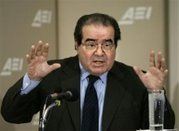
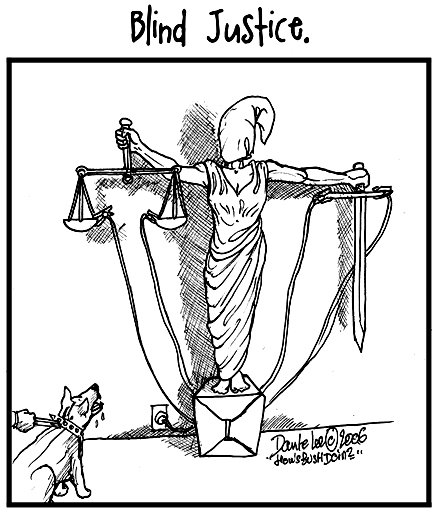
Supreme Court Justice Antonin Scalia Says "Enemy Combatants" have no legal rights; Scalia is wrong!
Scalia told an audience at the University of Freiburg in Switzerland that the Constitution does not protect foreigners held at the U.S. military prison at Guantanamo Bay, Cuba. And then he called European criticism of Bush "hypocritical".
Typically, Scalia's remarks are shot-through with circular fallacies and inconsistencies and —quite possibly —deliberate distortions. Due Process of Law is not limited to "citizens" of the United States as Scalia would have you believe. Moreover, denial of "Due Process" violates Nuremberg and Geneva —treaties to which the United States is bound. In any case, "Enemy combatant" is a term used arbitrarily by Bush; it is, conveniently for Bush, whatever Bush says it is. At last, the right of citizens to defend a homeland against the invasion of an aggressor nation is a settled principle of International Law. Scalia is wrong!
The term "enemy combatant" may or may not not apply to any one currently held in Guantanamo. The issue is Scalia's assumptive premise. If followed to its logical conclusion, we will never know the truth about how many "enemy combatants" —if any —are held at Guantanamo. The Bush/Scalia rationale seems conveniently designed to hide the truth. Denying Due Process to detainees is a sure way to accomplish just that. Taken to its logical conclusion, Scalia's doctrine gives to Bush the power to define American citizens as terrorist. Our rights under the Bill of Rights are thus gone forever.
According to the Washington Post, Scalia's comments came just weeks before the justices are to take up an appeal from a detainee at Guantanamo Bay. The court will hear arguments Monday on Salim Ahmed Hamdan's assertion that President Bush overstepped his constitutional authority when he ordered a military trial for the former driver of al-Qaeda leader Osama bin Laden. It would appear that Scalia has already made up his mind. The case will merely go through the motions.
Scalia's prejudice is revealed before the case can be heard. But that is hardly surprising. When the high court ruled two years ago that detainees could use U.S. courts to challenge their detention, Scalia disagreed. One wonders if he now has support he can count on from Roberts and Scalito.
"War is war, and it has never been the case that when you captured a combatant you have to give them a jury trial in your civil courts," Newsweek quoted Scalia as saying. "Give me a break."
Give
ME a break! Scalia habitually thinks backward —from his prejudice to a convenient rationalization, from conclusions already drawn to convenient premises. It was Scalia who said one of the most absurd things ever coughed up by a judge. Continuing the recount (in Florida), he said, would be harmful to George Bush. Excuse me! The one who gets the fewer number of votes is supposed to lose the election. But if you conclude that neither Bush nor Scalia have any interest in defending either Democracy or the Constitution it all makes sense.
The Constitution is just a goddamned piece of paper!—George W. Bush
Scalia's dissent in the
Rasul v. Bush case in 2004 said:
"The consequence of this holding, as applied to aliens outside the country, is breathtaking. It permits an alien captured in a foreign theater of active combat to bring a petition against the secretary of defense. . . . Each detainee (at Guantanamo) undoubtedly has complaints -- real or contrived -- about those terms and circumstances. . . . From this point forward, federal courts will entertain petitions from these prisoners, and others like them around the world, challenging actions and events far away, and forcing the courts to oversee one aspect of the executive's conduct of a foreign war."
Just a fusillade of words! What does Scalia have against learning the truth? Why would he prefer to remain ignorant of who the "enemy combatants" truly are based upon fact and evidence? Clearly —the summary injustice of rounding up people and holding them incommunicado, in secret, interminably, without access to attorney, without charges, without right of counsel, is not a recipe likely to win the hearts and minds of a people. Clearly —the Bush/Scalia formula has made terrorism worse and the world a much more dangerous place.
An audience member in Switzerland asked our prejudiced judge about whether Guantanamo Bay detainees have protection under the Geneva or human rights conventions. According to Newsweek, Scalia replied:
If he was captured by my army on a battlefield, that is where he belongs. I had a son on that battlefield and they were shooting at my son, and I'm not about to give this man who was captured in a war a full jury trial. I mean it's crazy,
Well, Scalia, I am addressing the following questions directly to you should you chance upon this blog: if we are, in fact, fighting a war —as Bush has told us we are —then how would you explain the capture of non-U.S. citizens on anything
other than a battlefield? If a citizen of a country that we have illegally invaded shoots back at us, does that not make it a "battlefield" by definition? If a foreign army invaded the United States would not citizens have the right to shoot back at them? What if that foreign power
lied about its reasons for invading us? At last, if the person in question is truly an "enemy combatant" would that not make a "battlefield" of the area in which the person in question is doing battle? At last —have we not made of all of Iraq a "battlefield" by invading that sovereign nation upon a pack of black-hearted, malicious, deliberate lies?
And now some questions for anyone who might chance upon this blog: doesn't it seem to you that Scalia does a lot "politicking" for someone who has an income for life? Doesn't it seem to you that Scalia does a lot of "campaigning" on behalf of partisan causes even as he would have you believe that he is an impartial arbiter of justice?
Related updates:
President's serial hypocrisy revealed againNews today in the New York Times:
[An] elite Special Operations forces unit converted one of Saddam Hussein's former military bases near Baghdad into a top-secret detention center. There, American soldiers made one of the former Iraqi government's torture chambers into their own interrogation cell. They named it the Black Room.
George W. Bush has been naked for years on these atrocities, preaching serial hypocrisy on torture with extraordinary balls, since he claimed back in 2003 that Iraq under his fatherly love would be ``free of assassins, and torturers, and secret police'' and that -- like he claimed three years ago this week -- that Iraqis no longer would have to fear the tyrant Saddam's ``torture chambers and rape rooms''. Seems those same torture chambers have instead been built up and enhanced, continuing to be scenes of torture under Bush to this day, two years after the Abu Ghraib story broke.
Deep Blade has covered serial hypocrisy on torture and rape in Iraq for years now. See entries here, here, and here among other places. A couple of years ago, William Saletan published a timeline called Rape Rooms: A Chronology What Bush said as the Iraq prison scandal unfolded -- damning indictments.
These are war crimes, for which Bush as Commander-in-Chief is ultimately responsible.
SUPREME COURT
This Tuesday, the U.S. Supreme Court will hear the case of Hamdan v. Rumsfeld. At issue is whether a detainee held at Guantanamo Bay is entitled to be tried by a civilian court, and whether the Geneva Conventions apply. New revelations reported by Newsweek cast some doubt on whether Justice Antonin Scalia will be sitting on the high court when opening arguments are heard. While speaking at an overseas conference on March 8, Scalia addressed the very issues the court will consider this week, asserting that the Constitution does not protect foreigners held in Guantanamo Bay, Cuba. (To watch Scalia's lecture, click here.) In a case involving the pledge of allegiance, Scalia did recuse himself because he had made comments prior to the case that left a reasonable doubt about his impartiality.
WHAT'S AT STAKE: The Bush administration has maintained that the Geneva Conventions do not apply to the conflict with al Qaeda and has established special military commissions to try these detainees without fundamental due process protections required by American and international law. Hamdan's lawyers, on the other hand, say their client and other detainees at Guantánamo are covered by the Constitution and should be afforded basic due process rights. Amnesty International has repeatedly urged the U.S. government to abolish the special military commissions because it contends the commissions breach fundamental standards for fair trial. Solicitor General Paul Clement, using arguments similar to those involved in the warrantless wiretapping issue, will argue that President Bush has the authority to subject captured enemy combatants to trial by military commissions through his inherent commander-in-chief powers under the Constitution and through Congress's passage of the 9/11 Authorization for Use of Military Force. Thus, the Hamdan case "will test the scope of presidential power in the war on terror. It may clarify how detained al Qaeda suspects are treated by the US." Also, it will address where the balance of power falls in terrorism cases related to national security.
SCALIA REVEALS HIS BIAS: In his lecture to an audience at the University of Freiburg in Switzerland, Scalia adamantly declared that the Constitution does not protect foreign enemy combatants held at Guantanamo Bay. "War is war, and it has never been the case that when you captured a combatant you have to give them a jury trial in your civil courts," he said. "Give me a break." Scalia's understanding of the legal rights of prisoners flies in the face of one of the Supreme Court's own rulings. In Rasul v. Bush, the Supreme Court specifically stated that allegations by detainees who have been detained without access to counsel and without being charged of any wrongdoing "unquestionably describe 'custody in violation of the Constitution or laws or treaties of the United States.'" There is reason to believe, given his comments, that Scalia would not give due regard this prior holding of the Court.
COMMENTS WERE RELEVANT TO THE CASE: Challenged on his beliefs about whether the Gitmo detainees have protections under the Geneva or human rights conventions, Scalia told the Swiss audience: "If he was captured by my army on a battlefield, that is where he belongs. I had a son on that battlefield and they were shooting at my son and I'm not about to give this man who was captured in a war a full jury trial. I mean it's crazy." The comments are particularly relevant to the case at hand because, according to Hamdan's brief, he was "apprehended on the field of battle in a war between the United States and the government of Afghanistan." In Hamdi v. Rumsfeld, Scalia wasn't nearly as dismissive of detainee's rights. In that case, he showed disdain for the creation of an alternative process of detention. And, of all the justices on the Court, he took the most restrictive view of Executive power of detention, arguing that Hamdi must be tried under criminal law unless Congress suspended the right to habeas corpus.
GROUNDS FOR RECUSAL: According to Father Robert Drinan, a professor of judicial ethics at the Georgetown University Law Center, the standard for recusal is that a justice "should remove himself when there is a reasonable doubt of his impartiality." Drinan added Scalia's most recent comments in relation to the Hamdan case "should logically be a reason for his recusal." Other legal pundits have suggested that Scalia may not need to recuse himself because he did not specifically refer to the Hamdan case in his comments. But in fact, the statute governing inappropriate judicial speech states that a justice "shall disqualify himself in any proceeding in which his impartiality might reasonably be questioned."
SCALIA'S STANDARD: Scalia previously recused himself from the Court's decision in Elk Grove Unified School Dist. v. Newdow, a case concerning whether the pledge of allegiance should have been banned from public schools due to its use of the words "under God." Prior to the Court's acceptance of the case, Scalia had remarked publicly that removing references to God would be "contrary to our whole tradition," and he suggested that courts did not have a role to play in changing the pledge of allegiance. Scalia's comments were not specific to the Newdow case, but rather, were related to the legal issue at hand, a noteworthy parallel to Scalia's most recent remarks on detainee's rights. Scalia explained he had, on the basis of "established principles and practices...said or done something" that required recusal. In another famous incident, Scalia decided not to recuse himself from a case involving his friend, Vice President Cheney. Scalia argued, "Since I do not believe my impartiality can reasonably be questioned, I do not think it would be proper for me to recuse." He argued he would recuse when, "on the basis of established principles and practices, I have said or done something which requires this course." That case did not involve allegations that Scalia had made pre-determined judgments on the legal issues at hand. Though a request for recusal can be submitted by one of parties to the Hamdan case, it is ultimately up to Scalia to determine for himself whether or not he will recuse. Should Scalia decide to recuse himself, it would leave the Court with seven justices to rule in Hamdan. (Chief Justice John Roberts has already recused himself from the case because he participated in a ruling on the case when he sat on the federal appeals court.)
An update:
San Jose Mercury News BY CAROL ROSENBERG. WASHINGTON - In a key test of President Bush's war powers, the Supreme Court grappled Tuesday with whether the Pentagon's plan to try Osama bin Laden's ex-driver before a special military commission violates international law and the U.S. Constitution.
Neal Katyal, the attorney for Salim Hamdan, argued that the Pentagon had concocted a charge - conspiracy - that isn't a war crime, had failed to grant Hamdan certain Geneva Conventions rights, such as prisoner-of-war status, and fell short of standards that Congress has set for how the United States must conduct either military or civilian justice.
"This is a military commission that is literally unbounded by the laws, Constitution and treaties of the United States," he told the court. ...