Friday, December 07, 2007

The Right Wing Threat of Theocracy

Mitt Romney and Mike Huckabee are misrepresenting if not lying about their theocratic tendencies. Contrary to what both candidates will tell you, the founders believed in a "wall of separations" between church and state. The US, in George Washington's words is "in no way founded upon the Christian religion".

The founders were, in fact, not very religious at all, and fewer still espoused the Christian religion. Thought Mitt Romney tries to brush it all off, there are very real concerns about the kind of regime either candidate would try to effect. There are valid concerns about both men's public religiosity, concerns about what Thomas Jefferson called a "wall of separation" between church and state.

Romney wants to have it both ways. Even as he claims that his status inside the cult of Mormonism will not influence "his" Presidency, he implied that the founders were Christians, that the US was, in fact, founded upon the principles of "Christian religion". Romney's position is absolutely wrong. It is at best a mistaken view of our history, at worst, it is a deliberate lie.

It was Thomas Jefferson, though not a "founder", who described a "wall of separation" between church and state. George Washington, a founder who presided over the Constitutional Convention, stated that the US "was, in no way, founded upon the Christian religion". [click the pic for Kevin Phillips' "American Theocracy"]

Of the many assaults on US liberty, the religious assault is the most pernicious. It is an evil influence cloaked in Godliness, premised as it is upon a pack of malicious lies about our history.

First things first --the founders were those delegates to Philadelphia who drafted the US Constitution at the Philadelphia Convention. "Christians" almost always get this wrong.

Most statements made by religious folk lump all the past and famous folk into one bag: founders. This, like almost every other thing they say, is just wrong and wrong headed. Those not present at the convention and who did not participate in the drafting of the Constitution are not founders. Thomas Jefferson, who was in France, was suspicious of what he characterized as an assembly of demigods. John Adams, likewise, was absent. Patrick Henry also did not attend and said of the convention that he "smelled a rat!" Nevertheless, James Madison, our charter's "architect", drafted a workable, secular government, and later, the legal framework for individual liberty: the Bill of Rights.

We are less free than our 18th Century forebears. George W. Bush represents a powerful fascist threat to US democracy. He ignores Congress, he re-writes the laws, he has abrogated habeas corpus, he has dismantled the separation of powers, he is, in fact, ruling by decree. He is a tyrant by any definition of the term. His has the potential to be the most harmful, the most damaging, the most pernicious dictatorship in world history.

When the US House passed the "Defense of the Ten Commandments" amendment to the juvenile justice bill, zealots of the Religious Right chanted the mantra: the USA is a Christian Nation! A press conference was attended by Gary Bauer and Rep. Robert Aderholt (R, Alabama), the sponsor of the amendment. Aderhold said:
The Ten Commandments represent the very cornerstone of the values this nation was built upon, and the basis of our legal system here in America".
Nonsense! And on various message boards, a chant, a mantra was taken up:
The legal foundation of this nation is the Ten Commandments
That is simply not true. In a single sentence, the founders put to rest any claim that this nation was, in any way, founded upon any religious principle of any type at any time.
Congress shall make no law respecting an establishment of religion, or prohibiting the free exercise thereof.

--US Constitution, First Amendment

I suggest radical fundamentalists read the Constitution, count the number of times the word "God" is used! As E.L. Doctorow so accurately pointed out in his essay, Jack London, Hemingway and the Constitution, the word God is not used once. Nor are the names of any deities used. There is, in fact, no reference to any deity of any religion, no reference to a source of supernatural power, no reference to a transcendent being, a primordial force, a first cause, an elan vital, a non-temporal, non-spatial Platonic ideal, an unmoved mover. The framers were having none of that.

This is not merely significant from a legal standpoint. Bluntly, with Faith-Based initiatives, Bush has robbed you in the name of God.
Opposition to Bush's faith-based initiatives has come from organizations including the American Civil Liberties Union and Americans United for Separation of Church and State. Both organizations have stated that the initiative represents an unconstitutional merging of church and state.

- Bush's Faith-Based Initiatives Launched

In constitutional terms, charitable choice boils down to this: religious organizations can receive government money to provide public services without sacrificing their religious character provided (1) the funding scheme does not somehow give bonus points to organizations simply because they are religious, and (2) individual users of the services have meaningful choices among providers and are only exposed to religious providers voluntarily. It’s an approach to First Amendment interpretation that over the last two decades has been gaining ground at the Supreme Court, evidenced most dramatically by this summer’s landmark decision blessing the use of education vouchers at religious schools.

- Dennis R. Hoover, Faith Based Administration

It is doubtful that any of Bush's "faith based initiatives" money has gone to Jewish, Islamic, or, indeed, any organization but Evangelical Christian organizations!
"Bush's faith-based initiative also privileges Christianity above all other religions. After sifting through every grant announcement I could get my hands on from Bush's faith-based offices, I couldn't find a single grant issued to a religious charity that wasn't Christian -- no Jewish charities, no Muslim charities, nothing. And when I spoke with Jim Towey, director of the White House Office of Faith-Based and Community Initiatives, he confirmed that no direct federal grants from his program had gone to a non-Christian religious group. This kind of religious favoritism is exactly what the Constitution's establishment clause was put in place to prevent."

- Esther Kaplan, Journalist and community activist

This is highway robbery. Your tax money finding its way into the coffers of Evangelical Christian organizations with which you most certainly disagree is most certainly theft!! You have been robbed. Like the Military/Industrial complex itself, Bush's axis of ideology is a racket designed to enrich his fundamentalist base.
"We will rid the world of evil doers"

--George W. Bush

The world would be better off now had Bush started with himself! The Bush administration represents an insidious, dangerous sea change in how this nation has viewed its own history. Right wing attempts to rewrite our history are insidious and Orwellian. The US, it must be repeated, is not a theocracy. The founders have cited no other authority for their work but the people themselves. God does not get even a footnote.

The US Constitution is not a "Ten Commandants" handed down by God. The US Constitution is the work of men, a convention of elected delegates to Philadelphia in 1787. If the Constitution should prove faulty, unworkable, or, in any other way, impractical, the people themselves bear the responsibility. It is no use blaming God.

The US Constitution is an existentialist document, a deliberate choice made by a people facing up to the facts of their founding, a people willing to take responsibility for a future they believed they could create, were free to create and adult enough to be responsible for. If God was to be summoned, it would be done by individuals free to act alone and within the dictates of their consciences. It would not be done by a theocracy; it would not be done by an act of Congress; it would not be done by a single article or phrase in the new charter; it would not be done by a GOP police state.

The US Constitution is significant by what it does not do. It does not cite a transcendent being as its source of authority. It does not favor the Christian religion, nor any religion, in any language. It does not cite or reference the works of theologians, saints, or prophets of any religion. It does not anoint a "King" who, in turn, cites a "divine right" to rule. The word "Christian" is not used once. Nor "Muslim", nor "Buddhist", "nor "Hindu". No article mandates a liturgy. No article mandates a day of worship. The names of deities, religions or sects are not mentioned.

The word "myth" is too kind for latter day ideologues who persist in trying to rewrite our nation's history. Assertions that our legal system is founded on the Christian Bible are more than mythical. They are deliberate lies manufactured and perpetrated by American fundamentalists like Pat Robertson and other evangelists who make big bucks in the God business, exploiting irrational belief systems, misconceptions, deliberate lies, and naive myths.
Neither a State nor the Federal Government can pass laws which aid one religion, aid all religions, or prefer one religion over another. Neither a State nor the Federal Government, openly or secretly, can participate in the affairs of any religious organization and vice versa. "In the words of Jefferson, the clause against establishment of religion by law was intended to erect `a wall of separation between church and State.' " Everson, 330 U. S., at 16, quoting Reynolds v. United States, 98 U.S. 145, 164 (1879). The dissenters agreed: "The Amendment's purpose . . . was to create a complete and permanent separation of the spheres of religious activity and civil authority by comprehensively forbidding every form of public aid or support for religion." 330 U.S., at 31-32 (Rutledge, J., dissenting, joined by Frankfurter, Jackson, and Burton, JJ.).

- The U.S. Supreme Court, ROBERT E. LEE, individually and as PRINCIPAL OF NATHAN BISHOP MIDDLE SCHOOL, et al., PETITIONERS v. DANIEL WEISMAN etc.

Following is the quote by Jefferson, referenced by the Justices, in which Jefferson referred to the "wall of separation" between church and state:
"Believing with you that religion is a matter which lies solely between man and his God; that he owes account to none other for his faith or his worship; that the legislative powers of the government reach actions only, and not opinions, I contemplate with sovereign reverence that act of the whole American people which declared that their legislature should `make no law respecting an establishment of religion, or prohibiting the free exercise thereof," thus building a wall of separation between church and State."

-- Thomas Jefferson's Letter to the Danbury Baptists, January 1, 1802

The justices have simply buttoned it all up. There is no ambiguity in the decision itself. There is most certainly none in Jefferson's phrase "wall of separation." We may dispense with the persistent myths about our "Christian" founders. For a start, few of them were Christian, if any. Many were deists. Others were, we suspect, atheists.
Deism is a religious philosophy and movement that became prominent in England, France, and the United States in the 17th and 18th centuries. Deists typically reject supernatural events (prophecy, miracles) and divine revelation prominent in organized religion, along with holy books and revealed religions that assert the existence of such things. Instead, deists hold that religious beliefs must be founded on human reason and observed features of the natural world, and that these sources reveal the existence of one God or supreme being.

- Wikipedia entry for "Deism"

Thomas Paine did say:
"I believe in one God, and no more; and I hope for happiness beyond this life.
But Thomas Paine was not a delegate to the Constitutional Convention in Philadelphia. He was not a founder however great his treatise: Common Sense. Then, of course, there is the opinion of the man who has was and is called the Father of his Country, George Washington:
"The United States is in no sense founded upon the Christian doctrine."

- George Washington

This sentiment would be echoed in the Treaty of Tripoli of 1797:
Art. 11. As the Government of the United States of America is not, in any sense, founded on the Christian religion; as it has in itself no character of enmity against the laws, religion, or tranquillity, of Mussulmen; and, as the said States never entered into any war, or act of hostility against any Mahometan nation, it is declared by the parties, that no pretext arising from religious opinions, shall ever produce an interruption of the harmony existing between the two countries.

- 1797 Treaty of Tripoli

About that, Tom Peters writes:
Does the 1797 Treaty of Tripoli say that "The Government of the United States is not, in any sense, founded on the Christian religion?" YES!

...

More generally, we can't imagine how the absence of Article 11 in the Arabic version effects [sic] the separationist argument. It was the English version of the treaty that was approved by President Adams and Secretary Pickering, and this version unquestionably contained Article 11. Similarly, when the Senate ratified the treaty, they did so knowing full well that the English version declared that the United States was not a Christian nation. The separationist implications of the treaty can't be escaped by arguing that the Arabic version may not have contained Article 11; the President, Secretary of State, and Senate thought it did, but approved the treaty anyway.

...

--Tom Peters, 1797 TREATY WITH TRIPOLI
This debate should be over, the case should be closed. By law, the separation of church and state is complete. But, as we have learned, the rule of law, under Bush, means nothing. As is typical of dictatorship in general, the "decrees" of George W. Bush replace the law itself.
To bolster their case, accommodationists have produced reams of quotations from famous early Americans to the effect that religion is important to public life, or that the founders themselves were religious men. As we demonstrate elsewhere, some of these quotes are either fabricated or taken out of context. Others (as we suggest in this section) are taken from people who were either opponents of the Constitution (eg., Patrick Henry), or who played no role in the framing of the Constitution or other important American documents (eg., Daniel Webster). Finally, we argue that the overwhelming majority of these quotations are irrelevant to what's at issue in the separation debate: one can be religious, and even believe that religion is important for public life, without believing that the state should have the power to aid religion, either preferentially or non-preferentially. -

Separation of Church and State Homepage

Fundamentalists have lately tried a different tact, arguing that the "wall" is "one way". In other words, government may not prohibit or, in any way, interfere with religion but that religion may interfere with the functions of government. But which religion? I wonder. Islam? Hindu? Certainly, America's Religious Right would confine such "interference" to Christianity. The late Steve Kangas argued that if the Founders had intended that our nation be a Christian Republic, they would have done so in the Constitution. They would not have separated Church and State.

Many of the founders, the authors of our Constitution, were Deists or atheists, not Christians; it would have been uncharacteristic, hypocritical, indeed, impossible for them to have intended a Christian Republic. By definition, religious control i.e, "interference" with the "state" infringes upon the rights of other sects, atheists, deists, or agnostics. The best refutation, however, is found in a decision of the US Supreme Court:
Neither a state nor the Federal Government can, openly or secretly, participate in the affairs of any religious organizations or groups and vice versa. In the words of Jefferson, the clause against establishment of religion by law was intended to erect 'a wall of separation between Church and State."

- The U.S. Supreme Court, ROBERT E. LEE, individually and as PRINCIPAL OF NATHAN BISHOP MIDDLE SCHOOL, et al., PETITIONERS v. DANIEL WEISMAN etc.

The Religious Right will often cite certain isolated professions of faith. In themselves, the quotes fall far short of proving that the founders had in mind founding the nation upon the Christian religion, indeed, creating a Christian theocracy. Worth repeating: the assertion that the US was founded upon the Christian religion is a pernicious, evil, destructive lie. And I happen to believe that facts are preferable to falsehoods. Facts are better than opinions. Facts are better than destructive myths.

Jefferson, moreover, backed up with deeds his belief that there should be a "wall of separation" between church and state. When Patrick Henry proposed to tax the citizens of Virginia in order to support "some form of Christian worship", Jefferson opposed it. He designed a bill for Religious Freedom which completely separated religion from government in Virginia. His bill passed while none of Henry's "theocratic" ideas were even introduced in either Virginia or US government.

The right, however, will cite other aspects of American history, the Pledge of Allegiance, for example. It must be pointed out, however, that the original pledge, authored by Francis Bellamy in 1892, did not contain the words "under God". I remember well when those were words introduced having first learned the original version. Moreover, it was not until after the Civil War that US currency had printed on it the words: "In God We Trust".

Nor can fundamentalists find a principle of law in a SCOTUS decision of 1892. In the case of Holy Trinity Church vs. United States, Justice David Brewer wrote that "this is a Christian nation." But Brewer wrote this in dicta i.e., a personal opinion. As a personal opinion so qualified by the justice himself, it does not establish case law. It is not a legal pronouncement. It does not have the force of law. Feeling obliged to explain, Brewer himself stated:
But in what sense can [the United States] be called a Christian nation? Not in the sense that Christianity is the established religion or the people are compelled in any manner to support it. On the contrary, the Constitution specifically provides that 'Congress shall make no law respecting an establishment of religion or prohibiting the free exercise thereof.' Neither is it Christian in the sense that all its citizens are either in fact or in name Christians. On the contrary, all religions have free scope within its borders. Numbers of our people profess other religions, and many reject all.

-

It may be left to the scrappy John Adams to close the book on the absurd assertions of religious folk.
"The United States of America have exhibited, perhaps, the first example of governments erected on the simple principles of nature; and if men are now sufficiently enlightened to disabuse themselves of artifice, imposture, hypocrisy, and superstition, they will consider this event as an era in their history. Although the detail of the formation of the American governments is at present little known or regarded either in Europe or in America, it may hereafter become an object of curiosity. It will never be pretended that any persons employed in that service had interviews with the gods, or were in any degree under the influence of Heaven, more than those at work upon ships or houses, or laboring in merchandise or agriculture; it will forever be acknowledged that these governments were contrived merely by the use of reason and the senses.

--John Adams, "A Defence of the Constitutions of Government of the United States of America" [1787-1788],

Though he had hopes that "...men are now sufficiently enlightened to disabuse themselves of artifice", he foresaw the present debate. In doing so, he gave us the best ammunition against them. Reason! I love his line "...it will never be pretended that any persons ... had interviews with the gods ..." Isn't it interesting that the 21st Century is in danger of slipping into a new dark age. It is equally interesting that the antidote is found in the lucid minds of 18th Century statesmen - Jefferson, Washington, Adams et al. It is time to put aside the campaign of lies by the Religious Right!

Mixing governance with religion is a bad and discredited idea as evidenced by those who espouse it.
"The national government ... will maintain and defend the foundations on which the power of our nation rests. It will offer strong protection to Christianity as the very basis of our collective morality."

--Adolf Hitler

Have not similar statements issued from the likes of Falwell, Robertson, Ashcroft, or George W. Bush and the American Taliban of John Ashcroft, Pat Robertson, and Gary Bauer?

At last, I refer interested readers to Joseph Storey's Commentaries on the Constitution - especially the significance he attributes to the Preamble which states:
"We the People of the United States, ... do ordain and establish this Constitution for the United States of America."
Significantly, the Preamble does not state that God ordained it, nor, indeed, any lawgiver but the people themselves. Nor is the Constitution based - as Gary Bauer had said - on the Ten Commandments. The "Ten Commandants" are not cited anywhere in the Constitution. Though it has the tone and voice of "Sacred Text" [See E.L Doctorow previously cited], the only authority cited by the Constitution is that of the people themselves.

That is important. According to Joseph Story, a preamble may not enlarge or confer power that is not found in the body of the document:
§ 459. The importance of examining the preamble, for the purpose of expounding the language of a statute, has been long felt, and universally conceded in all juridical discussions. It is an admitted maxim in the ordinary course of the administration of justice, that the preamble of a statute is a key to open the mind of the makers, as to the mischiefs, which are to be remedied, and the objects, which are to be accomplished by the provisions of the statute.

. . . . .

§ 462. And, here, we must guard ourselves against an error, which is too often allowed to creep into the discussions upon this subject. The preamble never can be resorted to, to enlarge the powers confided to the general government, or any of its departments. It cannot confer any power per se; it can never amount, by implication, to an enlargement of any power expressly given. It can never be the legitimate source of any impliedd power, when otherwise withdrawn from the constitution. Its true office is to expound the nature, and extent, and application of the powers actually conferred by the constitution, and not substantively to create them.

- Joseph Story, Commentaries on the Constitution, 1833

But until he is impeached, removed, tried, convicted and imprisoned, Bush conducts daily "interviews" with God. He has always implied a special relationship between him and a deity of his imagining. It is the basis of his dictatorship! It means that you are always wrong, Bush is always right. He's on a mission from God. He's not just a run of the mill, banana republic, tin horn dictator. He is infallible. He is the Pope!


Naomi Wolf Celebrated Author of "The End of America"

And now for something completely different.


Nessun Dorma by Pavrotti


Paul Potts Who Just Came to "Sing Opera"


Spread the word:

yahoo icerocket pubsub newsvine

Sunday, December 02, 2007

A Tale of Two Tyrants

by Len Hart, The Existentialist Cowboy

Putin out-Bushes Bush. In Russia, Vladimir Putin is supported by pro-Kremlin "youth groups" who equate or associate domestic opposition to Putin with supporters of George W. Bush. "You will not succeed in creating a revolution in Russia", they shout. Russia, they say, will never have an "American" style government. Bush, it seems, has not only created a tyranny in the US,
he inspires the domestic support for tyranny abroad.
Ten thousand young commissars — their title borrowed from the Communist Party leaders of the Soviet era — came here to learn to be Russia's next generation of tycoons and political leaders. Equally important, they came to prepare to stamp out any challenge from opposition groups to President Vladimir Putin's government.

All were summoned by Nashi, a pro-Kremlin organization that pays homage to Putin and seeks to promote Russia's resurrection as a superpower capable of frustrating what leaders call Western "imperialism."

--Russian youth rally at pro-Putin camp, USA Today

It has apparently never occurred to these young Russian "brownshirts" that, from my perspective, there is not a dime's worth of difference between Putin's increasingly fascist tyranny and that of George W. Bush in the US. If anything, Putin has outdone Bush even as Bush's excesses inspire support for Putin in the Russian homeland. As I have denounced the growing disparities of income in the US, a burgeoning oil industry has made possible even worse inequalities in Russia. My message to Putin's young supporters is this: you already have an Americanized government in the person of one Vladimir Putin and it is as bad as oil fascism American style --or worse!

In both Putin and Bush are found tyrants in the process of silencing dissent, consolidating power, procuring riches for their cronies. Both men are supported by a corporate "community" grown rich as a result of "fascist" policies. Bush is propped up by a dowager oil industry that must seek new resources abroad as it supports Bush adventures that promise them a pay-off.

Putin, meanwhile, has the luxury of presiding over a producing, domestic oil industry that need only punch a hole in the ground to pump up black gold. Putin is propped up for as long as the wells will pump. Putin and Bush are products of what can be only be described as "military/industrial" complexes. Wars are conceived by such "complexes" and wars are fought for their benefit.

It was all foreseen, prominently by St. Thomas More during the reign of Henry VIII.

...so God help me, I can perceive nothing but a certain conspiracy of rich men procuring their own commodities under the name and title of the commonwealth. They invent and devise all means and crafts, first how to keep safely, without fear of losing, that they have unjustly gathered together, and next how to hire and abuse the work and labour of the poor for as little money as may be.

-Of the Religions in Utopia, St. Thomas More
In 1795, Immanuel Kant wrote an essay called "Perpetual Peace". I find that interesting in view of the fact that we now find ourselves --by virtue of leadership both incompetent and criminal --in a state of "Perpetual War" In his treatise, Kant made quick work of the very concept of aggressive war:
A state is not, like the ground which it occupies, a piece of property (patrimonium). It is a society of men whom no one else has any right to command or to dispose except the state itself. It is a trunk with its own roots. But to incorporate it into another state, like a graft, is to destroy its existence as a moral person, reducing it to a thing; such incorporation thus contradicts the idea of the original contract without which no right over a people can be conceived.

--Immanuel Kant, Perpetual Peace

It could be argued that the United States has not, cannot "annex" Iraq --though Bush may have had that in mind. Every other ex post facto case for war has turned out to have been untrue, most often just black-hearted, deliberate, harmful, immoral lies! Though he will not admit it, Bush proposes to administer "our" new acquisition by way of puppet governments. What is falsely called an insurgency, however, has already plunged Iraq into Civil War. And because U.S. puppets do not have widespread support throughout this conquered territory, it lays bare the hypocrisy of the Bush position. Kant seems prescient when describing the political motivations behind wars of aggression:
...it is in part a new kind of industry for gaining ascendancy by means of family alliances and without expenditure of forces, and in part a way of extending one's domain.

--Immanuel Kant, Perpetual Peace

Believing war to be antithetical to reason, Kant advocated a federation of states bound by a covenant forbidding all war. Literally, a "United Nations". Kant, perhaps influenced by Montesquieu, describes a state in which an executive branch and a legislative branch are separate. Every form of government, Kant maintains, which is not representative is, in his view, "...without form".

It's interesting to speculate how revulsion to Robespierre's "Reign of Terror" may have moderated Kant's views.

Are the enemies within not the allies of the enemies without? The assassins who tear our country apart, the intriguers who buy the consciences that hold the people's mandate; the traitors who sell them; the mercenary pamphleteers hired to dishonor the people's cause, to kill public virtue, to stir up the fire of civil discord, and to prepare political counterrevolution by moral counterrevolution-are all those men less guilty or less dangerous than the tyrants whom they serve?

--Robespierre, On the Moral and Political Principles of Domestic Policy
I can only speculate that Robespierre's defense, above, was written after his "reign of terror" seemed to have turned upon itself and its own moderating elements. An example of its excesses is the execution of Lavoisier, one of twenty-eight French tax collectors, a powerful figure in the unpopular Ferme Générale. Lavoisier was branded a traitor during the Reign of Terror, convicted and guillotined on May 8, 1794. He was 50.

In our time, Joseph McCarthy and more recently George Bush exemplify demagoguery. You are either with us or you are for the terrorists! The Bush administration has repeatedly warned of additional "terrorist" attacks, "warnings" that are, in fact, thinly veiled threats to both the American people, American allies, indeed, the world. The implications are clear enough: dissent will not be tolerated; anyone daring to oppose Bush is considered to be in alliance with terrorists; those not conforming to the Bush orthodoxy with be dealt with by Bush's "Reign of Terror".

At home, the GOP simply, conveniently, and fallaciously defines "terror" as anything at odds with GOP dogma, orthodoxy, or propaganda. That orthodoxy, however, was described by Kant in 1795 when he referred to it in the words quoted above: "...it is in part a new kind of industry for gaining ascendancy by means of family alliances." A fair question arises: "has the GOP come to believe its own propaganda?"

According to Bertrand Russell, Kant is suspicious of Democracy and warns that the creation of the "executive" branch may lead to despotism. He most certainly had Robespierre in mind. Kant's "state" however, need not be without a King and he proclaims that a "perfect government" is more easily achieved by monarchy.

Nevertheless, it is a mistake to conclude that we must not aspire to Democracy because someone like Bush or Robespierre may pervert it or exploit it. Kant's position cannot persuade us that we must return to an era in which "Kings" rule by "divine right". Kant, however, may be considered to be a warning that if Democracy is not nurtured, it will most certainly be subverted by "...a new kind of industry". Kant could not have imagined what the US has made of this "new kind of industry" , this Military/Industrial complex!

Kant's use of terminology like "the whole people" seems akin to Jean-Jacques Rousseau about whom Sebastien Parmentier has written extensively on this blog [Sebastien Parmentier: Jean-Jacques Rousseau Between the lines]. Ironically, Rousseau seems also to have similarly inspired developments that both Kant and Rousseau would have preferred to avoid:
"If there had been no Rousseau, there would have been no Revolution, and without the Revolution, I should have been impossible."

--Napoleon

Kant presaged a "League of Nations" or "United Nations" and timidly described a separation of powers not nearly as well thought out as our own James Madison et al had already conceived at Philadelphia. It is interesting that Bush and Putin are the vanguard of a process that will consolidate their absolute and fascist powers. Given the apparatus at his command, his record with regard to a free press and the economic policies which have created an almost unimaginably wealthy elite, Putin is now poised to assume a permanent dictatorship. Bush, meanwhile, is content to compete with the likes of Warren Harding for "worst president ever". Certainly, he has worked assiduously to undo the advances we associate with the enlightenment and has thumbed his flared nostrils at Kant's dream of a "United Nations".

It the meantime, the US, another "dream" of Enlightenment thinkers, is itself becoming what it was never intended to be. William Ewert Gladstone called the US Constitution"...the most wonderful work ever struck off at a given time by the brain and purpose of man" It is tragic that it will die slowly of a thousand cuts.

In 1935, Sinclair Lewis penned the cautionary tale, It Can’t Happen Here, chronicling the fictional rise of Berzelius "Buzz" Windrip, who becomes President against the protests of Franklin D. Roosevelt and America’s saner citizens.

A charismatic Senator who claims to champion the common man, Windrip is in the pocket of big business (i.e. Corpos), is favored by religious extremists, and though he talks of freedom and prosperity for all, he eventually becomes the ultimate crony capitalist. Boosted by Hearst newspapers (the FOX News of its day), he neuters both Congress and the Supreme Court, before stripping people of their liberties and installing a fascist dictatorship.

-- Maureen Farrell, Can It Happen Here?
It did happen here! And it has happened in Russia.

Saturday, December 01, 2007

Why the GOP lies about the economy

by Len Hart, The Existentialist Cowboy

The United States has never been so polarized and never has the polarization made less sense. Never has it been more virulent. But --what if I were to tell you that Ronald Reagan was the biggest spending liberal of them all and John Maynard Keynes --reviled by Reagan-heads --was a conservative? What if I told you that Ronald Reagan failed when he actually did what he said he would do and succeeded when he did what he said he wouldn't?

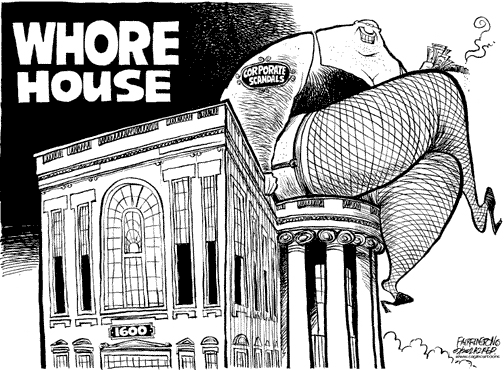
"Whore House" politics debases the language to facilitate their lies. They lie in order to cover up the the cloaked pay off. What passes for debate is irrational and needlessly vehement. It's all a smokescreen. The terms "liberal" and "conservative", for example, are all but meaningless in the world apres-Bush. The meaning of both terms are entirely different now than in the 19th Century, in fact, both terms are used differently in Europe than in the US.

For example, British economist John Maynard Keynes is habitually scorned by right-wingers. Not surprisingly, his brand of economics is called "liberal" if his name comes up at all. I daresay --most conservatives have probably never heard of him. Of those who ave heard his name, few understand him. Yet, Keynes took issue with Karl Marx on a key point: "I don't want a social revolution". Keynes, however, called poverty a "...dysfunctional threat" to a capitalist system which he favored.

I call favoring capitalism, "conservative". Nevertheless, that Keynes denounced "poverty" is enough to earn the enmity of modern conservatives who obviously like the feelings of superiority they experience when millions of others are without jobs and scrambling to feed themselves or, as Bush put it, to "...put food on your families".

It is Keynes' use of the phrase "...extending the traditional functions of government" that inspires conservatives to cross themselves and wear garlic. It was by "extending" those traditional functions that Keynes believed unemployment could be eliminated. This is, of course, anathema to laissez-faire throwbacks like Ron Paul whose economic thinking is stuck in the 19th Century.

The same conservatives are not bothered by "extensions of government" effected by Reagan, Bush Sr., and now the Shrub. Ronald's Reagan's program would have been thought "liberal" had the same program been advocated by a Democrat. Just as it is believed "Only Nixon could go to China", it is apparently believed that only a conservative can espouse a "liberal" agenda and get away with it.

Hypocrisy is expedient. Until Bush Jr, Ronald Reagan was our biggest spending liberal. He tripled the national debt, ran up historically high deficits, and doubled the size of the Federal Bureaucracy. None of it worked as planned because none of it benefited working Americans. Reagan had in mind "extending the traditional functions of government" but only in order to benefit the wealthy and the corporate. It is only when "extending the traditional functions of government" benefits the middle or poorer classes that "conservatives" object to "liberal" policies. "Conservatives" love welfare when it benefits elites who don't need it.

Some history may illustrate the point: the Wall Street crash of 1929 was followed by a severe world wide depression acutely felt in the U.S., Germany, France, and to a lesser degree --Great Britain and Sweden. Nevertheless, unemployment was high in Sweden when that nation returned a Labor government committed to a program of public investment to address the high unemployment problem. It worked. By 1935 real output in Sweden was 7 percent above its 1929 level. Unemployment was reduced and the finance minister was said to have been happy to suffer another budget deficit to stimulate the economy.

To be fair, the US also spent itself out of the Great Depression. The differences are that it occurred much later, and then it was due to the massive military spending necessary to wage World War II. The US has been addicted to war ever since. Spending in Sweden tended to benefit not merely the rich elites but, rather, the population as a whole. The US "experiment" benefited but a few monied defense contractors and birthed the egg from which a Military/Industrial complex would hatch.

Ronald Reagan's budget deficit did not have as happy a result as those achieved peacebly in Sweden. Reagan's spending should have resulted in comparable widespread, near universal prosperity. But because it was a payoff instead of a program, his tax cut of 1982 was quickly followed by the nation's worst recession since the Great Depression, a recession of some 18 months characterized by record levels of unemployment, home losses, the newly poor sleeping under bridges and overpasses. For having been screwed by "Unca" Ronnie, the recent poor were called "crazy" by Reagan and his GOP disciples.

The explanation is simple and may be found in the writings of Reagan's budget director, David Stockman who blamed a "noisy faction of Republicans" for Reagan's infamous tax cut. Reagan might have achieved the prosperity that Keynes had predicted had his policies not been designed to reward only the filthy rich elite, in other words, his base. It was said that his tax cut would stimulate new investment and create new jobs --the vehicle by which the increased wealth would trickle down! It all sounds good in theory. The mountain of stats at the Bureau of Labor Statistics, BEA, and elsewhere clearly prove that the wealth never trickled down: the rich did not re-invest the tax cuts. There were no new jobs.

One wonders why Reagan didn't just cut out the middle man. A more equitable tax might have put more spendable income directly into the hands of consumers. Spent money circulates and drives an economy. That consumers spend money seems to be a fact lost on the likes of Reagan, Bush, and the nation's rich and callous elites.

Surely, there were knowledgeable advisers in Reagan's regime who knew better. The tax cut, therefore, was entirely political, a pay off to the rich for their support. Nothing has changed in the GOP. The Bush administration has made several such "payoffs" during his catastrophic and criminal regime.


The 'Cowboy' on Facebook

Media Conglomerates, Mergers, Concentration of Ownership, Global Issues, Updated: January 02, 2009


Tuesday, November 27, 2007

Oil Traders Seize Control of World Oil Prices

A shadowy cabal of international "oil traders" have seized control of the world's markets and the price of oil. That's not the opinion of a crazed "conspiracy theorist". It is the informed opinion of an expert market analyst interviewed by the prestigious Foreign Policy magazine.

As oil reached $100 recently, Foreign Policy magazine asked the question: who stole the oil? Fadel Gheit, one of Wall Street's top energy analysts, believes that the world price of oil is no longer tied to the market. In other words, powerful international traders have seized control of the world's primary source of energy.
I truly believe that major investment banks and a large number of very high-risk-taking financial players have seized control of the oil markets, especially in the last six months. During that time, oil prices moved in one direction and market fundamentals really moved sideways or even lowered. Demand has slowed down significantly. We have seen all kinds of indications that we are reaching a breaking point here. We’ve seen what happened to gasoline margins on the West Coast; they’ve dropped to an almost 18-year low. All this is an indication that something is wrong with the system, that supply and demand fundamentals do not justify the current price. But if the current price is based on speculation, there is no limit to how high oil prices can go. Basically, as long as there is somebody willing to bid higher, the price of the commodity will move higher.

-Fadel Gheith, Seven Questions: The Price of Fear, Foreign Policy
Oil, of course, was rising concurrent with the dollar's fall. OPEC's take was simply the rise in oil offset their own dollar losses in the currency markets. It was in middle October that many analysts had already written that many investors trying to hedge their dollar losses amid predictions that another cut in US interest rates would drive the buck even lower, and oil even higher. Gheith is probably correct about oil. The question then is: qui bono? Who benefits most from both the dollar's fall and the rise of oil?

In October, crude had already reached an historic high above $80 a barrel. In the same breath analysts pointed to the "weakening dollar" and inflation. Inflation of course, threatens consumer spending, even cheap Chinese imports from Wal-Mart. The future is now. Or --is it?
To my knowledge, there is no oil shortage. Any willing buyers will not have a problem finding oil. Global inventories are over 4 billion barrels. In simple math, that is the equivalent of all the oil produced in the Middle East for six months. So, the fear premium, in my view, is totally exaggerated; it’s not justified by logic or market fundamentals.

--Fadel Gheith, Seven Questions: The Price of Fear, Foreign Policy
I find it incredibly interesting that only those oil barons, typified by Dick Cheney's Energy Task Force, are precisely the group fingered by Gheith as benefiting most from the spread. In other words, US war hawks have probably lost nothing from the dollar's fall that hasn't been made up with the sale of oil.
... it’s very difficult to quantify fear. But that is the psychological factor, in my view, that is bringing oil prices to these unprecedented levels. For instance, I don’t believe that Iran is going to cut oil exports, because Iran needs the revenue more than the world needs Iran’s oil. We have to be logical in assessing the risk. And obviously, financial players want to exaggerate the situation so that the risk premium increases and they make more money.

--Fadel Gheith, Seven Questions: The Price of Fear, Foreign Policy
Bush created the task force in his second week in office. Officially known as the National Energy Policy Development Group, it was charged with developing a national energy policy. When documents related to their secret meetings were, at last, released, it was clear that the "Energy Task Force" had simply carved up the Middle East, just as surely as Hitler had intended to carve up the resources of Europe and Russia.

I smell a rat...or just the evil stench associated with Bush's oil regime?


Iraq War

Spread the word:

yahoo icerocket pubsub newsvine

Sunday, November 25, 2007

It's Time to Flog Our "Government"

The fall of the dollar means that Americans will pay more for almost everything. The "correction" had been overdue since the US became a debtor nation, a process completed under Ronald Reagan. It was on September 16, 1985, that the Commerce Department announced that the United States had become a debtor nation and it was on that day that the American Empire died. Since that date, the GOP has been content to let consumers suck up the trade deficit with fewer real jobs. The GOP got away with it as long as China propped up the buck in order to fill the shelves at Walmart. An emerging stronger Euro changed everything.

The collapse of the dollar might not have mattered as much if the US had not over many years of incompetent GOP missrule and corruption become a net debtor nation. US consumers are utterly dependent upon "cheap" merchandise from abroad; a falling dollar is catastrophic.

So far, CNN and the US media seem to be treating this like a novelty story, a "kicker" at the end of the real news. Like the Democrats who thought they could "play" Bush's game and win, they just don't get it. The average American may not "get it" but he will most surely pay for it.

Like almost every stupid thing that has happened to the US since World War II, the GOP is mostly to blame. But Democrats should be flogged for letting them get away with it.

Iraq changed everything by pressing the point and Bush is to blame for bankupting the US with his vainglorious adventure in Iraq. The American people will pay dearly for Bush's on-going act of mass murder in Iraq.

Though Democrats were, at one time, villified as "big spending liberals", it is the GOP that has run up the highest debts and deficits. Just as terrorism is always worse under GOP regimes, debts and deficits are, likewise, greater during periods of GOP missrule.

The world might have tolerated our many follies as long as they could pass along bucks received for the goods sold the US. But, alas, the chain is broken. A growing number of people and nations now refuse the dollar. It was all, literally, a "confidence" game, in which all the world has lost confidence.

War is a racket fought by the masses for privileged elites, big corporations, and venal politicians like Bush. Bush's quagmire is fought for the benefit of no-bid contractors like Halliburton and Blackwater. The war is financed by America's working poor and middle classes who pay for the war —with their lives abroad and with their jobs, their retirement prospects, and their access to health care at home.

Bush's base —the nation's elite, his corporate sponsors, and the so-called defense industry —have paid nothing, risked nothing! Rather —they feed at the trough. The upper one percent of the population has gotten several tax cuts while the big oil companies report record profits rising concurrently with higher prices at the pump.

Just two days after 9/11, I learned from Congressional staffers that Republicans on Capitol Hill were already exploiting the atrocity, trying to use it to push through tax cuts for corporations and the wealthy. ... We now know that from the very beginning, the Bush administration and its allies in Congress saw the terrorist threat not as a problem to be solved, but as a political opportunity to be exploited. The story of the latest terror plot makes the administration’s fecklessness and cynicism on terrorism clearer than ever.

Hoping for Fear, by Paul Krugman, Using Fear Commentary, NY Times
There are big profits in the death business. Go to Texas and consult the CEO of Murder, Inc. , otherwise known as DynCorp.
The war in Iraq has boosted DynCorp's revenues, responsible for about $400 million of the company's nearly $2 billion in sales. And while the company didn't specify how much the effort has added to profits, there has certainly been an upside, Lagana said, although he added that profit margins are lower than in other private industry -- often below 10 percent.

For government contractors and other US-based businesses that are doing work in Iraq, the war there has continued to provide opportunity and benefits, although experts and companies alike say they are difficult to quantify. To be sure, security businesses, oil producers and defense contractors are among the biggest winners. Those who manufacture key products, from bulletproof vests to bullets themselves, and, more recently, those involved in reconstruction, have reaped the benefits, too.

--Businesses find benefits, costs in war work
Money is not the soiled and over-designed scraps of paper that we carry around and pass off in exchange for "things". Money is, at last, mere faith. China, especially, had "faith" that their confidence in the almighty buck would be repaid by US willingness to buy all sorts of cheap Chinese crap at Wal-Mart and other blights on the American urban landscape. The Chinese would get it all back as long as the rest of the world was willing to wink and nod.

The result is that Shanghai and other cities have out-Americaed, America. They have taller and uglier buildings and worse traffic amid the worst air pollution on the planet. Houston and LA look green by comparison. China is a ecological blight on the planet. The lesson one hopes China has learned is that there is price to be paid for having partnered with Satan.

Wal-Mart makes a killing putting people out of work, depressing local economies, and lowering wages but it is globalization --an unholy alliance with GOP "trickle down" policies --that spawned Wal-Mart and sounded a death knell for the futures of American workers. Most recently, Wal-Mart's Chinese imports have displaced nearly 200,000 US jobs

China’s entry into the World Trade Organization (WTO) was supposed to improve the US trade deficit with China and create good jobs in the United States. But those promises have gone unfulfilled: the total US trade deficit with China reached $235 billion in 2006. Between 2001 and 2006, this growing deficit eliminated 1.8 million US jobs (Scott 2007). The world’s biggest retailer, US-based Wal-Mart was responsible for $27 billion in US imports from China in 2006 and 11% of the growth of the total US trade deficit with China between 2001 and 2006. Wal-Mart’s trade deficit with China alone eliminated nearly 200,000 US jobs in this period.

Robert E. Scott, The Wal-Mart effect
The Wal-Mart effect on US workers and manufacturing is typified by the effects seen in clothing --low-cost goods with a hidden higher price: lower wages, lost jobs. Underlying every sector, however, are unsupportable US trade deficits which benefit American consumers but only so long as they have jobs themselves.

As has been the trend at least since the regime of Ronald Reagan, manufacturing suffers most as Wal-Mart grows more intrusive, exploiting the trade deficit with its own undervalued currency. In effect, American consumers have financed China's economic boom.

Of some 133,000 manufacturing jobs lost in the US, sixty-eight percent were the direct result of Wal-Mart's "partnership" with China. The effect is devastating to US workers and the US economy overall. Manufacturing jobs, after all, have generally paid higher wages and provided better benefits.

The US-China trade deficits amount to more than $1 trillion in US Treasury bills and growing. It is fair to say that China has done this deliberately to rehabilitate its own economy on US backs. It has had the effect of lowering the cost of its exports to the United States and other countries.
The relationship between the dollar and the yen has been affected primarily by the adverse trade balance that we have with Japan. At the last summit meeting in London, for instance, we discussed the very high positive trade balance that Japan enjoyed then. The goal established by your own leaders was that this trade balance would be reduced. Instead, it's continued to go up.

I think, as the economic market leaders have recognized, the high export of Japanese goods and the relatively low imports into Japan of other goods, the yen has strengthened in comparison to other currencies, including, of course, the American dollar.

- President Jimmy Carter, Interview with Western European and Japanese Reporters, July 11th, 1978

What a foolhardy game of brinkmanship this has become! It is tempting to write that China has more to lose by a collapsing buck than does the US. Certainly Bush concluded thus as he parked the US Fifth Fleet in the Persian Gulf, where it is tracked undetected by Chinese subs.

Money is whatever people will accept as payment for goods and services. As long as the rest of the world was confident that they could pass along their bucks or exchange them equitably, the US was not overly concerned about "fundamentals".

I am now told in Europe that the strength of the dollar abroad is inexorably linked to Bush's credibility abroad. We are, therefore, screwed. Bush has no credibility. And most Americans don't have the luxury of demanding that they be paid in some other currency.


Iraq War

Spread the word:

yahoo icerocket pubsub newsvine