Sunday, July 16, 2006

Bush has de-stabilized the middle east, strengthened Iran, abandoned Lebanon

In the face of a disproportionate response by Israel, the US has abandoned Lebanon, the best hope for democracy in the Middle East. Bush's attack, invasion and illegal occupation of Iraq has irreparably undermined American influence and power everywhere in the Middle East. If what Bushco had said of Iran is true, then Bush risks driving Lebanon into an alliance with Iran at a time when the US has eschewed its traditional role of 'honest broker'.

The US failure to restrain Israel has only strengthened Iran president Mahmoud Ahmadinejad who has already become a major player in the world wide scramble for Middle Eastern resources. As Israel's disproportionate attack on Lebanon nears the end of its first week, the fact that Lebanon —hitherto the region's best hope for Democracy —will find more in common with Iran than with the US who has clearly left Lebanon to its fate at the hands of Ehud Olmert. The so-called great game is lost; Bush, if not checkmated, is, at least, checked in what Zbigniew Brzezinski called The Grand Chessboard

In the year 2003, Juan Cole wrote:

Most Shiite leaders in Iraq have made a tactical decision not to resist the Anglo-American occupation during the coming year. They hope the US, in recreating Iraq as a parliamentary democracy, will give them the political power they deserve by virtue of their numbers. If not, or if the Americans overstay their welcome, the Shiites might well turn against them. It is not, however, clear that the community is united enough yet to effectively close ranks against coalition forces.

—Juan Cole, Shiite divisions give the US breathing room

Brzezinski's thesis, however, was taken up by Bushco, a group easily swayed by grandiose and megalomaniacal visions of American pre-eminence in a post-Soviet world. Brzezinski's thesis encouraged less gifted thinkers to envision the Bush administration holding absolute sway throughout the Middle East from oil-rich former Soviet satellites to the shores of the Mediterranean.

Instead, Iraq has become a black hole pointing up the fatal inconsistencies in Bush's plan for world dominance if not outright conquest.

Chess players will understand this analogy: Bush lost the game with a flawed opening. As early as July of 2003, the BBC would report that "...the new Centcom commander, John Abizaid, said coalition forces were facing what looks like a systematic guerrilla war". The Bush administration failed to understand and fully appreciate that much of the Middle East is less "state" oriented than tribal in nature. Power throughout the region is, therefore, capable of coalescing unpredictably to outside threats. In Iraq, specifically, Bush failed to anticipate the rise to power of a Shi'ite theocracy capable of forming an alliance with Bush's boogie-man du jour: Iran.

Shias account for about 90 percent of the Iranian population, some 70 percent of all people living in the Persian Gulf region. About 140 million people living in an area from Lebanon to Pakistan call themselves Shias; that's about 50 percent of all people in that region. It's not surprising that Bush himself would have been ignorant of these elementary facts. It is inconceivable, however, that Condoleeza Rice, as National Security Advisor at the time, would not have done at least five minutes of basic research before consenting to complicity in Bush's decision to commit US troops to a war of naked aggression cum quagmire cum disaster.

By liberating and empowering Iraq's Shiite majority, the Bush administration helped launch a broad Shiite revival that will upset the sectarian balance in Iraq and the Middle East for years to come.

...

Iraq's liberation has also generated new cultural, economic, and political ties among Shiite communities across the Middle East. Since 2003, hundreds of thousands of pilgrims, coming from countries ranging from Lebanon to Pakistan, have visited Najaf and other holy Shiite cities in Iraq, creating transnational networks of seminaries, mosques, and clerics that tie Iraq to every other Shiite community, including, most important, that of Iran.

—Vali Nasr, Foreign Affairs, When the Shiites Rise
Reportedly, the Bush administration is worried about the way the world is trending. That's cold comfort. It is Bush and his gang of incompetents who may be credited with having fanned the flames. Could Bush have behaved otherwise? Yes —but only if he had represented the interests of the people of the United States instead of the combined interests of Dick Cheney's Halliburton, Exxon-Mobil, Unocal, the since failed Enron, and other representatives of big oil. Their long term interests are the control of the world price of the world's most addictive drug: Oil! American democracy and world peace are just not very high on their list of misplaced priorities.


The Existentialist Cowboy

Saturday, July 15, 2006

Israel and Lebanon: How Bush lost his mojo

Accustomed to dictating the agenda, putting opponents on the defensive, dividing the rest of the world into good and evil, black and white, yin and yang, the Bush administration is now reduced to watching an escalating Middle East conflict from the sidelines. There are several reasons for that, but most prominently America's diminishing role throughout the world —traceable to Bush's failure in Iraq, the world wide rejection of his discredited policy of pre-emption, and the nature of the "new government" —if government it is —in Iraq.

Israel will ignore UN calls for restraint and the conflict will intensify because a principal player is missing in action, or should we say, inaction. That player is the United States —bogged down in Iraq, finding itself unable to restrain Israel, without any chance of dialogue with Syria or Iran. Bearing the brunt is Lebanon to whom the US can only say: "Hang in there, buddy!"

Over three decades, the US has tempered inflammatory situations, playing "good cop" to the Israeli "bad cop". Having given tacit approval to an Israeli "over-reaction" , the Bush administration compromises its traditional role of "honest broker". Without dialogue or leverage, Bush is not only out of the loop, he may even be on the wrong side.

Likewise, Israel lost control of the agenda when Hamas won recent elections in Palestine, a situation very nearly summed up by the Washington Post:

Since Hamas won control of parliament in the recent Palestinian elections, policymakers in Washington and Jerusalem have been faced with a dilemma: how to deal with a democratically elected government that is also on the State Department's list of foreign terrorist organizations. Last week, Newsweek-Washington Post's Lally Weymouth interviewed Hamas's new prime minister, Ismail Haniyeh, by phone in his home in the refugee camp where he lives with his wife and 12 children in Gaza.

Palestinian President Abu Mazen and the international community have put forward conditions for dealing with Hamas: 1) recognize Israel; 2) recognize existing agreements with Israel made by the Palestinian Liberation Organization; 3) renounce violence. Will you agree to these conditions?

We are surprised that such conditions are imposed on us. Why don't they direct such conditions and questions to Israel? Has Israel respected agreements? Israel has bypassed practically all agreements. We say: Let Israel recognize the legitimate rights of the Palestinians first and then we will have a position regarding this. Which Israel should we recognize? The Israel of 1917; the Israel of 1936; the Israel of 1948; the Israel of 1956; or the Israel of 1967? Which borders and which Israel? Israel has to recognize first the Palestinian state and its borders and then we will know what we are talking about.

—'We Do Not Wish to Throw Them Into the Sea', Washington Post
Tragic irony! Bush's neocon base have long supported Israel and would have supported an Israeli nuclear strike on Iran. Iran, of course, now has close ties with the Shi'ites who now call themselves the government in Iraq. By way of Hezbollah, Bush's new Shi'ite government in Iraq may find itself in a war with Israel. More simply: Bush had no clue! Bush had no idea what he was getting into when he ordered US troops into harm's way in Iraq. Now Bush is reduced to watching it all unfold on TV.

Bushies will resort to form: the no one could have foreseen defense. We've all heard it before. Condoleeza Rice used it following 911 when she said that no one could have foreseen that hijackers would use airliners. That was not so, of course; everyone but Bushco had "gamed" it.

More recently, Bush himself whined to Diane Sawyer: no one could have foreseen that the levees would break. In fact, everyone but Bush had foreseen that possibility. National Geographic did a documentary about it. Now, Bush can be counted on to come up with something equally absurd like no one could have foreseen that Shi'ites would win the elections in Iraq or no one could have foreseen that Israel would want to attack Lebanon. Who is dispensing those mind altering drugs at the White House?

Additional resources:


The Existentialist Cowboy

Friday, July 14, 2006

American conservatives are dead wrong and why it matters

According to John Dean in his new book Conservatives Without Conscience, Ric Santorum said: "Conservatism is common sense; liberalism is ideology". Therein lies the crux of the problem. Conservatives cannot think clearly about themselves, let alone "liberals" whom they've irrationally demonized over a period of some 30 to 40 yeas. Santorum is most certainly not the first self-confessed "conservative" to get it wrong; he is, however, among a radical elite who often get it 180 degrees the wrong way 'round.

Historically, conservatives have always criticized "liberals" from their ideological biases, primarily religious and economic. Liberals were too pragmatic, they said, and were lacking ethics based upon religious conviction. It's a fair question: when did those godless pragmatists suddenly become ideologues? My cynical response is: godless pragmatists and empiricists suddenly become ideological when Santorum's focus group told him that ideological was a better word with which to tar his opponents. Certainly the term liberal is by now a golden-oldie epithet so overused as to be a self-inoculating cliche. It doesn't even seem to be working for Rush Limbaugh who has a worse problem than drugs. Ratings!

The radical right is running out of red flag words. Liberal was so worn out that Ann Coulter had to call her book Slander and then: Treason! Now she's reduced to attacking the widows of 911 victims. What's next? Either it is true that Rush and Ann have not gotten that memo or it is true that you can't teach old dogs new tricks. It'll be interesting to see what the focus groups come up with. Easy livings depend upon something good ...or should I say evil?

Dean also quotes former Reagan aide, Michael Deaver who wrote of conservatives that they favor:
...limited government, individual liberty, and the prospect of a strong America. —Michael Deaver, as quoted by John Dean, Conservatives Without Conscience
If conservatives are claiming now to be empirical and pragmatic, how is Deaver's comment to be taken seriously? Verifiable facts disprove Deaver's thesis. Let's take Deaver's three points in turn.
  • Conservatives believe in limited Government.
Oh Really? Let's start with Ronald Reagan, whom conservatives have all but deified. Reagan tripled the national debt and ran up historically high deficits. Despite a respite in the 90's the bad old days are back under Bush, a fact not lost on some fiscal conservatives:
From 2000-2003, Washington had a rare opportunity to save the average household nearly $2,500 in taxes without reducing any federal services. After 50 years of steady increases, interest payments on the national debt declined by $247 billion from 2000 to 2003, thanks to the balanced budgets of the 1990s. Like the post-Cold War “peace dividend,” Congress and the president got a once-in-a-lifetime “interest dividend” of $247 billion.

And they squandered every penny.

—Capitol Magazine, Washington's $782 Billion Spending Spree

That was published in 2002. It's only gotten worse since then.

Conservatives would also have us believe that it's liberal entitlements that account for the sorry state of the US budget. That's not so either. From the same conservative source:

Others finger big-ticket entitlements such as Social Security, Medicare and Medicaid, claiming that they're growing uncontrollably. However, these program's budgets haven't grown any faster over the last four years than they did over the past two decades.

—Capitol Magazine, Washington's $782 Billion Spending Spree

    James Carville charged that Ronald Reagan significantly increased the Federal Bureaucracy in We're Right, They're Wrong; typically and unfortunately, however, Carville will be summarily dismissed by partisan Republicans and especially when he's absolutely correct and on target. He's both on this point. I have other sources for that information:
    When Ronald Reagan was elected in 1980, the popular belief was that the size of government would be cut and that some of the regulatory excesses of the prior decade would be rolled back. However, the growth of the federal government continued throughout the Reagan presidency and no agencies were phased out.

    —Regulation and the Reagan Era: Politics, Bureaucracy and the Public Interest, Roger E. Meiners, Bruce Yandle (Editors)

    In fact, Reagan increased the federal bureaucracy by 68,000 workers even as he very nearly tripled the national debt.
    Reagan’s legacy is clear in the budget deficit neighborhood. He entered the White House in January 1981–after winning the presidency by campaigning that tax cuts and massive increases in defense spending could co-exists with a balanced budget. The budget deficit was $74 billion when he entered the White House; it grew to $231 billion in Reagan’s final year. The trade deficit was even worse, nearing $200 billion per year when Reagan left office. The national debt rose to $2 trillion.

    —Michael Fauntroy, Reconsidering Reagan

    These are facts that Republicans will deny to this day.
    • Conservatives believe in individual liberty
    Is that so? Not if they support George W. Bush. Nowhere has Bush attacked the separation of powers more strenuously than with his so-called unitary executive concept. At stake are regulatory agencies, independent since the Great Depression. Control has been shared between President and Congress. Bush would tip the balance of power by putting the agencies under his sole control and authority.

    Elsewhere, Bush strikes at the very heart of individual liberties: the Bill of Rights. Many people seem to be unconcerned about their phone calls and their bank records, objects of Bush's program of widespread domestic surveillance. But, alas, it's not about bank records; it's not about phone calls. It's about probable cause —two words that stand between us and tyranny.

    • Conservatives are stronger on national defense
    Are they really? In fact, terrorism increased during Reagan's administration. We were less safe and even less safe now under Bush! During a period some two years in which Ronald Reagan waged a so-called "war on terrorism", terrorist attacks against the United States very nearly tripled. [Source: Total Acts of Terrorism in the U.S. 1980-98, America's Response to Terrorism, The Brookings Institute (Based on FBI Statistics)]

    Typically, Reagan announced his "War on Terrorism" to a meeting of evangelicals on March 8, 1983. Reagan warned terrorists: "You can run but you can't hide"! A statistical analysis would seem to indicate that Reagan's War on Terrorism was as much a cause as a cure for terrorism. There are two possible explanations. One, Reagan's war —not well thought out —was simply impotent and ineffective. It may even have been counter-productive, a rallying cry to legitimate critics of US imperialism as well as terrorists.


    Or —the raison d'etre may have been to rally a disparate GOP base. Typically, wars are easily exploited to stir feelings of patriotism and false pride.

    Just as Reagan's war made Americans less safe, Bush's war is increasingly perceived as making the world a more dangerous place. According to Pew, American skepticism about the war in Iraq has increased steadily from its inception; it is increasingly seen as harming the "war on terrorism".

    A plurality (47%) believes that the war in Iraq has hurt the war on terrorism, up from 41% in February of this year. Further, a plurality (45%) now says that the war in Iraq has increased the chances of terrorist attacks at home, up from 36% in October 2004, while fewer say that the war in Iraq has lessened the chances of terrorist attacks in the U.S. (22% now and 32% in October). Another three-in-ten believe that the war in Iraq has no effect on the chances of a terrorist attack in the U.S.

    —Pew Research Center, Iraq Hurting War on Terror

    The level of vituperative rhetoric has dangerously divided and radicalized the right wing. John Dean, whose book I have previously referenced, still thinks himself a Barry Goldwater conservative though he has been among George Bush's most vocal critics. That he looks like a liberal now, he says, is only a measure of how far right the right has become. In fact, many so-called "conservatives" who support Bush are not conservative at all by Deaver's definition. They favor big and intrusive government; many, like Dick Cheney, believe deficits no longer matter; and, others —neocons in particular —openly pine for another Pearl Harbor that might be exploited for political purposes. [See: Project for a New American Century] Radical authoritarians, they have little in common with "conservatives".

    Barry Goldwater may have been the last conservative. Indeed, he may have been the first —a short-lived movement of one. Certainly, contemporary conservatives have little in common with anyone who would tell John Dean that the conscience of a conservative was pricked by "any action or anything that debases human dignity". Dean asked: "Doesn't poverty debase human dignity?" Of course it does," Goldwater replied. He went on to tell Dean that if the family, friends, and private charities cannot handle the job, then the government must.

    It sounds like FDR.

    That Goldwater and Eisenhower would be called liberal today reveals the polarization that has taken place in this country. A radicalized right wing is a cancer upon the body politic; its roots are found in the left overs of Nixon's utterly failed administration. This is something about which Dean can write authoritatively. It was Dean, after all, who warned a President of a cancer on the Presidency.

    Tragically — our enemy within takes the form of an increasingly authoritarian right wing which exemplifies what Sartre called mauvaise foi —bad faith! I've rarely believed what conservatives say about liberals, but even less of what they say about themselves. It is not unusual for a politician to lie to others. Conservative lies to themselves, however, are especially pernicious and destructive. Another word is delusion; delusion is a symptom of psychosis.

    Sadly, many conservatives do not see themselves as subversives even as they support Bush assaults on the Constitution. The biggest lie yet told is that Bush took us to war to bring Democracy to Iraq. Perhaps, then, when he has done so, we should all move to Iraq so that we might enjoy the blessings of Democracy. We've all but lost them here at home. It was Jay Leno, as I recall, who asked: Why don't we let Iraq have our Constitution. We don't have any use for it anymore!

    Thom Friedman recently asked: What does being right have to do with anything? Let him go to Iraq where he will learn what being dead wrong and lying about it has to do with everything!

    Additional resources:


    Spread the word:

    yahoo icerocket pubsub newsvine

    Monday, July 10, 2006

    Bush and his Iraq war tar baby descend into hell

    Facts on the ground have overtaken delusions and lies. Here's a quick round-up from media and blogosphere, painting a picture of Iraq descending into anarchy and chaos amid increased incidents of mass murder, rape and other war crimes by an illegal US occupation.
    Iraq is continuing to deteriorate. The bloody curse of the Bush/Cheney/Rumsfeld/Rice fiasco is reaching a pure descent into Hell, yet the mainstream corporate media is still providing a veneer of credibility to Bush, when all around the world is crumbling.

    —Buzzflash Editorial

    Maureen O'Dowd writes:

    Baghdad Erupts in Mob Violence

    BAGHDAD, July 9 — A mob of gunmen went on a brazen daytime rampage through a predominantly Sunni Arab district of western Baghdad on Sunday, pulling people from their cars and homes and killing them in what officials and residents called a spasm of revenge by Shiite militias for the bombing of a Shiite mosque on Saturday. Hours later, two car bombs exploded beside a Shiite mosque in another Baghdad neighborhood in a deadly act of what appeared to be retaliation.

    While Baghdad has been ravaged by Sunni-Shiite bloodletting in recent months, even by recent standards the violence here on Sunday was frightening, delivered with impunity by gun-wielding vigilantes on the street. In the culture of revenge that has seized Iraq, residents all over the city braced for an escalation in the cycle of retributive mayhem between the Shiites and Sunnis that has threatened to expand into civil war.

    The violence coincided with an announcement by American military officials that they had formally accused four more American soldiers of rape and murder, and a fifth soldier of "dereliction of duty" for failing to report the crimes, in connection with the deaths of a teenage Iraqi girl and three members of her family. ...

    Former US soldier charged with killings, rape in Iraq

    A former US soldier discharged from the Army with a personality disorder has been accused in court of raping an Iraqi woman and killing her and her family in March, US officials have said.

    Former Private first class Steven Green, 21, who was stationed in Iraq with the 101st Airborne Division, appeared in court in Charlotte, North Carolina, and is expected to be sent to Kentucky where he has been charged with the attacks that took place in Iraq.

    Green faces a possible death penalty if convicted. He has been charged as a civilian, but could be brought back on military duty and charged as a soldier, a defence official said.

    According to a statement by the US attorney in Kentucky, Green is charged with going to a house near Mahmudiya with three others to rape a woman living in the house. ...

    Another bleak report, this one from the Rubicon:
    That criminal negligence starts at the top, negligence of Iraqi civilians and American soldiers alike. George Bush is the commander who first set the tone, notably in his juvenile challenge three years ago:

    Anybody who wants to harm American troops will be found and brought to justice. There are some that feel like if they attack us that we may decide to leave prematurely. They don't understand what they are talking about if that is the case. Let me finish. There are some who feel like the conditions are such that they can attack us there. My answer is, bring 'em on.

    "Let me finish," he whines. It's well past time to interrupt his swaggering speeches—and his feckless military adventures. Bring the American militia home now. It's the only way to bring the killing to an end.

    As of today, these are the numbers of the dead:
    • 2,543 American military personnel
    • 226 other coalition military personnel
    • at least 341 coalition contractors
    • more than 100,000 Iraqi civilians—at least 38,901 deaths have been fully documented in online media reports
    • about 9,000 Iraqi military (during the invasion)
    • at least 91 journalists
    And in Afghanistan, 317 American soldiers and 91 other coalition soldiers have died.
    The bloodshed and chaos in Iraq is beyond description. Making the task harder for working journalists on the scene is the fact that travel and access are restricted. Bush, meanwhile, wages another war on any media that dares to tell the truth about his quagmire.

    Seven Questions: Covering Iraq

    Reporting from Iraq has become one of journalism’s most difficult and dangerous jobs. FP spoke recently with Rod Nordland, who served as Newsweek’s Baghdad bureau chief for two years, about the challenge of getting out of the Green Zone to get the scoop.

    FOREIGN POLICY:

    Are Americans getting an accurate picture of what’s going on in Iraq?

    Rod Nordland: It’s a lot worse over here [in Iraq] than is reported. The administration does a great job of managing the news. Just an example: There was a press conference here about [Abu Musab al] Zarqawi’s death, and somebody asked what role [U.S.] Special Forces played in finding Zarqawi. [The official] either denied any role or didn’t answer the question. Somebody pointed out that the president, half an hour earlier, had already acknowledged and thanked the Special Forces for their involvement. They are just not giving very much information here.

    FP: The Bush administration often complains that the reporting out of Iraq is too negative, yet you say they are managing the news. What’s the real story?

    RN: You can only manage the news to a certain degree. It is certainly hard to hide the fact that in the third year of this war, Iraqis are only getting electricity for about 5 to 10 percent of the day. Living conditions have gotten so much worse, violence is at an even higher tempo, and the country is on the verge of civil war. The administration has been successful to the extent that most Americans are not aware of just how dire it is and how little progress has been made. They keep talking about how the Iraqi army is doing much better and taking over responsibilities, but for the most part that’s not true.

    FP: How often do you travel outside of the Green Zone?

    RN: The restrictions on [journalists’] movements are very severe. It is extremely dangerous to move around anywhere in Iraq, but we do. We all have Iraqi staff who get around, and we go on trips arranged by the U.S. State Department as frequently as we can.

    Clearly —Bush, his Neocon gang, the war hawks of both parties in Congress, and Bush supporters throughout the nation were wrong about Iraq amid a cacophony of jingoistic crowing, boycotts of French fries and Dixie Chicks. Dead wrong!

    As Iraq fell apart, Thom Friedman still had the nerve to ask: "What does being right have to do with anything?" Let him go to Iraq! He will at least learn what being wrong has to do with everything!


    The Existentialist Cowboy

    Saturday, July 08, 2006

    What would you do if you were tortured?

    A war is lost when atrocities begin.
    Fascism is not defined by the number of its victims, but by the way it kills them.

    —Jean-Paul Sartre

    Even if whatever had been said about Saddam had been true, it is now equally true of Bush; but, of course, what was said of Saddam was not true. What is said of Bush now is! As Bush conned the American people into complicity, Deputy Defense Secretary Paul Wolfowitz painted a rosy picture of "the first Arab democracy". It would be a secular society, he said, ignoring the fact that it already was. The new Iraq would be oil rich and middle class. Aside from the fact that Wolfowitz might have been describing the GOP, Iraq had already been all of those things. The other more well known reasons for war —WMD, for example —have likewise proven to be either bald-faced lies or irrelevant nonsense. There were numerous ex post facto justifications. They, too, have been overtaken by events.

    It was hoped that the US army in Iraq would moderate Iran, isolate Mullahs, weaken Hezbollah and other so-called "radical" groups. In every case, the opposite has occurred. Shiites in Iraq are the "government" and have formed an alliance with Iran. If Bush attacks Iran, "his" new Iraqi government will ask the US to leave. Radical groups —flagging prior to the US attack and invasion of Iraq —gain new converts daily. Just as Bush used radical Islam to rally the Christian right, "radical Islam" need only raise the spectre of Christian crusaders or Abu Ghraib to draw a sympathetic crowd.

    Marc Lynch, Assistant Professor of Political Science at Williams College, has concluded that so dramatic are Bush's reversals that the administration is no longer promoting democracy in the middle east:

    On al-Arabiya last week, Hisham Milhem led a discussion on "Bush and democracy in the Arab world."....I was most struck by a remark by Amr Hamzawy. He pointed that the fact that most of the Arab media and political class were now discussing the "retreat" of American commitment to democracy demonstrates that at least at one point they were prepared to entertain the thought that there had been some credibility to that campaign. No longer, Hamzawy argued — America's turn away from democracy and reform had badly hurt its image and its credibility with this Arab political class....This seemed to be a well-received notion.

    —Abu Aardvark

    Even moderate regimes now feel threatened. The US may have only one friend in the Middle East —Israel. And, lately, that friendship is problematic.

    Professor Marjorie Cohn states unequivocally: “Israel’s brutal retaliation against Palestinian civilians constitutes collective punishment. Attacks on a civilian population as a form of collective punishment violate article 50 of the Hague Regulations”, “The Fourth Geneva Convention also prohibits collective punishment. Article 33 …” and “Collective punishment is likewise forbidden by Article 75 of Protocol I to the Geneva Conventions. As four US Supreme Court justices agreed in Hamdan v. Rumsfeld last week, Article 75 is “indisputably part of the customary international law.””[see:Marjorie Cohn Israel Creates Humanitarian Crisis].

    Complicating the US position is the sheer hypocrisy of it all. The rising tide of atrocities has turned the middle east irrevocably against the US even as secular nations now associate US troops with Abu Ghraib, Haditha and the CIA with an eastern European gulag. We have yet to reap the full effect of the gathering storm.

    Most startling of all is Sartre's advocacy of violence as a legitimate response to repression, motivated by his belief that freedom was the central characteristic of being human.

    —From a review of Colonialism and Neocoloniam by Jean-Paul Sartre

    GOP propaganda —while working for awhile —is transparently hypocritical:
    If certain acts in violation of treaties are crimes, they are crimes whether the United States does them or whether Germany does them, and we are not prepared to lay down a rule of criminal, conduct against others which we would not be willing to have invoked against us.

    —Justice Robert Jackson, Chief Prosecutor for the United States, Nuremberg Tribunals

    When the rich wage war, it's the poor who die.

    —Jean-Paul Sartre

    Citizens of a sovereign nation may resist an occupying force in any way they can including armed resistance. It's a principle of international law. Resistance to the US occupying force in Iraq is, therefore, not an "insurgency". The word 'insurgent' implies illegitimacy.

    The recent Supreme Court decision is a step in the right direction. As more cases reach the high court, it will become clear that the US presence violates Nuremberg, Geneva, and the UN Resolution that was often incorrectly cited by Bushco.

    "Freedom fighters" are never called "insurgents" —even if they are. One can only conclude that like "supply side economics", the word "insurgent" was chosen at the end of a GOP focus group session for its propaganda value, its ability to frame the issue. In the meantime, I will support in any way I can an international movement to bring the entire Bush gang of war criminals and mass murderers to justice at the Hague!

    I have vague recollections of the struggle for Algerian independence and upon a quick refresher, I was impressed yet again by the strenuous opposition to the French position from Jean-Paul Sartre.

    I know that we are accused of treason. But I ask, who and what do we betray? Judicially we are plunged in a civil war, since the Algerians are considered full French citizens; we thus don’t betray France. In fact, the national community no longer exists; where are its great axes, where are its lines of force, where are the fixed points of its structure?

    ...

    And now, what? There is no longer one family in Algeria that hasn’t had a member of its family join the maquis or been tortured or killed by the French. Hundreds of thousands of men, women and children of that country eat the grass on the Tunisian and Moroccan borders. 15%-20% of the Algerian population, nearly two million inhabitants of this “French province” are concentrated in camps where an average of one child a day among a “regroupement” of 1000 people dies every day, which comes to about 1500 children a day in total. Must we console ourselves by noting that in these camps there are neither gas chambers nor crematory ovens? And should we feel any scruples about rising up alongside the Algerians against those who inflict this on them, or who content themselves with deploring the fact that others inflict it on them? When things have reached such a point there is no longer room for a third camp; one is either with one side, or with the other.

    —Letter from Francis Jeanson to Jean-Paul Sartre

    At the time this letter was written, Sartre had taken a strong stand against torture. In his Critique of Dialectical Reason, Sartre said of torture that it was intended "...to reduce men to vermin". Like the US in Iraq, the French used torture to suppress the Algerian resistance. And like the Bush administration which denies that it tortures even as it defends the practice, the French were equally contradictory; they denied it had ever taken place while declaring its effectiveness against the Algerian Liberation Front. True to his existentialism, however, Sarte had the courage to denounce the practice even as he urged others to ask of themselves as he asked of himself: what would I do if I were tortured!

    In his unfinished and never produced play about Sir Thomas More, William Shakespeare urged his audience to "...take the stranger's case"! If we, as Americans, are to retain what's left of our humanity, we simply must take the case of the Iraqi people. We must demand that the atrocities end now! We must rise up and demand that the United States withdraw immediately from Iraq! We must demand full and transparent investigations into every outrage perpetrated by the US military in Iraq. We must ask of ourselves as Sartre asked of himself: What would you do if you were tortured?

    A final observation about Sartre who adamently defended the leftist La Cause du Peuple . He might have been in serious trouble had he not been seen as the new Voltaire. In my opinion, there is no greater patriot than one who would —in good faith —criticize his own country when that country is morally, even mortally wrong!

    Sartre did not confine his remarks to France. A link supplied to this site by Station Agent, takes you to a speech by Sartre in which he excoriates imperialism, neo-colonialism, and the attempted American genocide in Viet Nam:

    The American government is not guilty of having invented modern genocide, nor even of having chosen it from other possible answers to the guerrilla. It is not guilty - for example - of having preferred it on the grounds of strategy or economy. In effect, genocide presents itself as the only possible reaction to the insurrection of a whole people against its oppressors. The American government is guilty of having preferred a policy of war and aggression aimed at total genocide to a policy of peace, the only other alternative, because it would have implied a necessary reconsideration of the principal objectives imposed by the big imperialist companies by means of pressure groups. America is guilty of following through and intensifying the war, although each of its leaders daily understands even better, from the reports of the military chiefs, that the only way to win is to rid Vietnam of all the Vietnamese.

    It is guilty of being deceitful, evasive, of lying, and lying to itself, embroiling itself every minute a little more, despite the lessons that this unique and unbearable experience has taught, on a path along which there can be no return. It is guilty, by its own admission, of knowingly conducting this war of ‘example’ to make genocide a challenge and a threat to all peoples. When a peasant dies in his rice field, cut down by a machine-gun, we are all hit.

    Therefore, the Vietnamese are fighting for all men and the American forces are fighting all of us. Not just in theory or in the abstract. And not only because genocide is a crime universally condemned by the rights of man. But because, little by little, this genocidal blackmail is spreading to all humanity, adding to the blackmail of atomic war. This crime is perpetrated {364} under our eyes every day, making accomplices out of those who do not denounce it.

    In this context, the imperialist genocide can become more serious. For the group that the Americans are trying to destroy by means of the Vietnamese nation is the whole of humanity.

    —Jean-Paul Sarte, On Genocide, International War Crimes Tribunal - 1967

    Faced with a guerrilla war, misleadingly called an "insurgency" by Bush propagandists, the illegitimate regime of George W. Bush has already involved this nation in numerous criminal acts. Our presence in Iraq is a quaqmire increasingly characterized by mass murder, rape and other atrocities. There is no victory to be achieved. Out of Iraq now! War crimes trials for Bush and his co-conspirators!

    And a thanks to Mike's Round up at Crooks and Liars. Mike has linked back to the "Cowboy", adding a couple of enhancing links:
    The Existentialist Cowboy: "If certain acts in violation of treaties are crimes, they are crimes whether the United States does them or whether Germany does them, and we are not prepared to lay down a rule of criminal conduct against others which we would not be willing to have invoked against us." —Justice Robert Jackson, Chief Prosecutor for the United States, Nuremberg Tribunals

    We’re gonna need a guide to understanding fascism.

    Related to the issue of the lawlessness of the Bush regime, this update:

    Supreme Court’s Ruling in Hamdan Means Warrantless Eavesdropping is Clearly Illegal

    Ever since the Supreme Court in the Hamdan case ruled that the Bush administration’s Guantanamo Bay military commissions violate both federal law and the Geneva Conventions, the President has been paying lip service to his "willingness" to comply with that ruling. But the Court’s ruling goes far beyond the limited question of whether military commissions are legal. To arrive at its decision, the Court emphatically rejected the administration’s radical theories of executive power, and in doing so, rendered entirely discredited the administration’s only defenses for eavesdropping on Americans without the warrants required by law.

    Actual compliance with the Court’s ruling, then, compels the administration to immediately cease eavesdropping on Americans in violation of FISA. If the administration continues these programs now, then they are openly defying the Court and the law with a brazenness and contempt for the rule of law that would be unprecedented even for them ...


    The Existentialist Cowboy

    Friday, July 07, 2006

    The Rise and Fall of The Enron Empire

    by Len Hart, The Existentialist Cowboy

    The recent death of Ken Lay revived memories of a corporate scandal that seemingly triggered the fall of lined up dominoes. I had hopes that the truth about corporate America would trigger some real reforms, a sea change in American attitudes about how business is conducted, and, at least, some introspection about the shallowness of American culture.

    I was dissappointed. Greed still motivates corporate robbers barons. Corporations are still considered to be "persons" in the eyes of the law. At the time, I asked: what happened to Enron? Occupying its own gleaming glass and steel skyscraper in downtown Houston, Enron seemed invincible, epitomizing what it meant to be an American corporation. That turned out to have been its downfall.

    As much of the world suspected at the time, the American corporation was revealed to be a shell. Enron, for example, produced nothing. It bought and sold natural gas and manipulated spot market prices. It's huge purchasing power literally put the screws to California; the result was a long hot summer of rolling black outs and power shortages. Enron executives and traders were tape recorded cackling and hooting over California's problems --problems that bore the Enron trademark.

    What then was the source of Enron wealth? Aside from the profits made manipulating markets, Enron was the recipient of some $10 billion from Saudi royals who still have questionable ties to both Bush and world wide terrorist organizations. That the money was morally tainted didn't stop Kenneth Lay and the robber barons of Enron. Enron was, in fact, in business with "bankers to the terrorists". Only the incurable incurious would not want to know more about the Enron connection to known 'terrorist' organizations --especially those having ties to George W. Bush, Dick Cheney and the 'American' oil industry.

    Since the Reagan "revolution" and the rise of dubious economic theories like "supply-side" economics, the actual manufacture of anything of value seems to have fallen to Chinese corporations. The effect has been a cancer on the American economy, beginning with Reagan and having resumed with George W. Bush.

    American companies are encouraged by all too friendly, conservative regimes to engage in questionable business practices. The political climate in which these huge businesses operate is much more than merely pro-business, it seems to be anti-everything else. There are large margins for error when tax breaks favor you, and your company can write-off a panoply of follies, inefficiencies, and borderline behaviors. Enron literally created new subsidiaries out of thin air and put a "book" value on them that had more to do with delusion, megalomania, and psychosis than it did with economics or accounting.

    That's old news. I am more inclined to confine my focus to the effects this "pro-business" climate has had on the American "character". For example: do we still have character?

    Before the rise of Bush, America, despite her many shortcomings, was still admired around the world. Now, we are reviled; and if the various religious and secular guests on a recent installment of Bill Moyer's Faith and Reason are accurate, the world wide revulsion to American culture has reached epidemic levels.

    One does not have to be an Islamic radical to find America crass, obsessed with bigness for the sake of bigness, and arrogant for the sake of feeling "cool". Nevermind that there is no hard evidence to support Bush's official conspiracy theory of 911; I have concluded that to the degree that there is a real terrorist threat, it is nothing more nor less than blow-back, a fatal resistance to the arrogant bully on the block.

    Now George W. Bush has made of America, the "state" version of Enron. The fact that this nation is financially as well as morally bankrupt is papered over with lies that must surely be compared to Enron's phony books. Many Enron employees, for example, were encouraged to take part of their salary in company stock i.e. you let me cut your salary and I'll make up the difference with worthless pieces of paper —Enron stock. On the national level, Bush tried to sucker retirees out of their Social Security with an equally dubious plan.

    Of course a good "con game" requires a willing and greedy sucker. Enron was seen to be a place where employees were seduced into believing that after ten years they could retire rich in Sugarland —Tom Delay's ultra-conservative district. The three words that summed up the Reagan years also describe Enron and the administration of George W. Bush. Those words are: Greed is good!

    Because greed is good, all orgnizations, especially American corporations, will inevitably trend toward inefficiency and mediocrity. An American middle manager, for example, is not likely to hire anyone smarter than he/she; secondly, he/she will look for someone that is "like" him/herself. Should the surprisingly competent get hired, he/she will probably leave for a better job where the cycle will repeat itself. Meanwhile, mediocrity, like sour cream, will rise to the top. The truly bright and talented don't go to work for corporations and, if so, it's only until they find something better. The "company man" is not likely to change the world, is not likely to leave a footprint on history. Corporations are not looking to hire philosophers, honest politicians, revolutionaries, poets, or dramatists.

    Power for its own sake has become the corporate raison d'etre, just as it similarly motivates Bush and Bushie. Corporate power is based upon an absurdity —that corporations are individuals and have all the "rights" of individuals. Moreover, corporations, if they are to be considered "people", must certainly be seen to be psychopaths. For this reason, the Bush administration, as a collective, as a corporatized government, should be locked up and straight-jacketed.

    It was the Reagan administration that began the corruption of American values despite sticking on the word "family". In retrospect, the Reagan administration can be thought of as proto-Bush. Adding their own absurdities to the the moral rot, the Bush regime threatens to bring down this country like Enron, like the Twin Towers, like a collapsing bag. To greed is good has been added Thom Friedman's what does being right have to do with anything?

    Thus Friedman has made his lasting contribution to American culture. In the future, when one wants to describe a society in which nothing of value is valued, where only lies are celebrated, they will quote Friedman. Indeed, if being right has nothing to do with anything, what difference did it make that Enron's subsidiaries were almost all entirely fictitious? Friedman may consider himself 'lucky' for claiming that dubious phrase; it might have been puked up by an Enron executive some six years ago.


    Thursday, July 06, 2006

    A Death Too Convenient

    It is not only Kenneth Lay's cozy connections with Dick Cheney that makes his sudden death a matter of extreme public interest. Lay's death may hide forever the subtle connections between Enron, Dick Cheney's Energy Task Force, 911, the Saudi Royals, and the war against Iraq.

    For a start, Ken Lay's death takes the heat off the Bush family, primarily because Lay was at the very nexus of the Bush/Saudi axis of oil and energy. In death, there are no more tales to tell save for what can be pieced together thus far. The source for much of the following information is a captured document that, according to former federal prosecutor, John Loftus, was produced by Al Qaeda. The document supports charges of a cover-up. Ongoing terrorist investigations were said to have been shut down or interfered with even as the Enron Corporation negotiated with the Taliban for pipeline rights through Afghanistan.

    Who ordered the cover up? Why was Enron made off limits to federal investigation? Who but someone very high up in the Bush administration could have shut down such an investigation? Who, in fact, did?

    From that document and other bits and pieces, the following picture emerges.

    Before 911, US energy companies were secretly negotiating with the Taliban to build a pipeline across Afghanistan. Unocal and Enron executives met with Taliban representatives in Tom DeLay's district of Sugar Land in 1997, an event that seems suspicious in retrospect. At the time, however, no one was suspicious of oil men flying in and out of Houston. It happens every day.

    On another occasion, some 40 Enron representatives met with the Saudi royals in Tashkent. Enron was at the time "...the Afghan pipeline consultant for UNOCAL" [See Loftus vs. Sami Al Arian]; Prince Turki, son of King Faisel, was chief of Saudi intelligence. Also present at the Tashkent meeting was a Unocal consultant: Hamid Karzai —now called derisively the "Mayor" of Kabul.

    At the time, the Saudis were pumping money into Enron. The Saudis wired some $10 billion "... from a Cypriot bank through Barclay's Bank in London and on to Houston" in a bid to make of Enron a "player" in the ongoing pipeline negotiations —but why? What kind of deal had Enron struck up with Prince Turki, the ruling Saudi royals, and the Bush administration?

    Prince Turki, who made several trips into Afghanistan, dismisses them as mere peace missions. That rings hollow. Officially, the talks were about pipelines —not war! Peace missions are made to prevent wars, not pipelines. Did Prince Turki spill the beans?

    As the Saudis placed heavy bets on Enron, the Bush State Department was at work on another front —threatening the Taliban with carpet bombs should the negotiations break down [See Forbidden Truth]

    Eventually, the pipeline discussions would collapse and Prince Turki would be fired as head of Saudi intelligence. It's a safe bet, however, that he's still a major player. He was in Houston just last week. He is most certainly still close to the Bin Laden family which, according to Loftus, was promised "the" construction contract [the pipeline contract, presumably] in return for a "baksheesh" [kickback] to the Saudi Royal family. According to Loftus, this is a common business practice initiated by the Carlyle Group's contracts in Saudi Arabia.

    As the Republican IPO magazine, Red Herring, confirms, President Bush' father was business partners in the Carlyle Group with the Bin Laden family during this period . This company is a Who's Who of former Democratic and Republican intelligence and political officials, whose specialty is acting as super-lobbyists at the highest levels of government. They are also suspected of arranging construction kickbacks to the Saudi royal family in return for discount oil sales. —Former Federal Prosecutor, John Loftus
    Loftus has filed a private lawsuit, Loftus vs. Sami Al Arian, currently pending in Hillsborough County, Florida. It is credited with having shut down what Loftus has called the "Saudi funding conduit" and with having influenced a government raid of so-called Saudi Charities in the US. The lawsuit charges bluntly that the charities were not charities at all, rather, they "...were fronts for networking with other terrorist groups." From the lawsuit:
    75. Under the guise of an ICP educational conference, Defendant and/or his agents and servants, repeatedly invited known international terrorists and leaders of extreme racist organizations to the United States. [FBI tr. P.1]

    76. Defendant’s own videotapes show that Defendant regretted that some of the people he invited were prevented from attending his ICP conference, including the “Blind Sheik” who was later investigated for the first bombing of the Twin Trade Towers, and was afterwards convicted of another conspiracy to bomb New York landmarks. [FBI Tr. P.1]

    77. In order to facilitate the process of obtaining visas for terrorists to attend Defendant’s terrorist conventions, Defendant, his agents and servants incorporated yet another purported non-profit entity in the State of Florida known as the “World Islamic Studies Enterprise.” (WISE).

    If these allegations are true, I want to know who was funneling money into the Saudi charities. The 911 plot might also be exposed if we but knew to whom the monies are funneled.

    There is reason to believe that many of these things were discussed with Enron's Ken Lay. There is reason to believe that the pipeline may have been the number one item on the agenda when Lay participated in a meeting of Dick Cheney's energy task force.

    Documents turned over in the summer of 2003 by the Commerce Department as a result of the Sierra Club’s and Judicial Watch’s Freedom of Information Act lawsuit, concerning the activities of the Cheney Energy Task Force, contain a map of Iraqi oil fields, pipelines, refineries and terminals, as well as two charts detailing Iraqi oil and gas projects, and “Foreign Suitors for Iraqi Oil field Contracts.” The documents, dated March 2001, also feature maps of Saudi Arabian and United Arab Emirates oil fields, pipelines, refineries and tanker terminals. There are supporting charts with details of the major oil and gas development projects in each country that provide information on the project’s costs, capacity, oil company and status or completion date.

    Documented plans of occupation and exploitation predating September 11 confirm heightened suspicion that U.S. policy is driven by the dictates of the energy industry. According to Judicial Watch President, Tom Fitton, “These documents show the importance of the Energy Task Force and why its operations should be open to the public.”

    When first assuming office in early 2001, President Bush's top foreign policy priority was not to prevent terrorism or to curb the spread of weapons of mass destruction—or any of the other goals he espoused later that year following 9-11. Rather, it was to increase the flow of petroleum from suppliers abroad to U.S. markets.

    —Secrets of Cheney's Energy Task Force Come to Light

    But not all of the information was released following the lawsuit by Judicial Watch. Now, it would appear, that it will never be known to what extent the Bush administration betrayed the people of the United States and fabricated a pretext to invade both Afghanistan and Iraq.

    May Kenneth Lay rest in peace. Death among Bush cronies seems to be as statistically high as GOP votes from a DieBold machine. Lay's probable complicity in the crime of the century will remain obscure on the whole and completely unknown in its details.

    Jacob Bronouski had reasoned from sheer logical positivism an ethic: behave in such a way that what is true may be verified to be so! But —tragically —the Bush administration typifies an opposite and amoral view —what I call the Thom Friedman cop out: what does being right have to do with anything? It's a question that only the dead wrong would ask. Of Ken Lay, who is remembered in Houston by his many victims, it is a death too convenient!


    The Existentialist Cowboy

    Monday, July 03, 2006

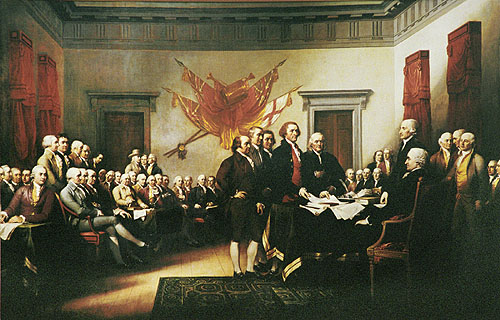
    A Declaration of our Independence

    At a time in our history when the President of the United States claims to be above the law, when the nation has been taken to aggressive war upon a pack of lies, when the Congress scrambles to make legal ex post facto the crimes the "President" has already committed, when the Supreme Court states bluntly that the President is a war criminal, when the private conversations and bank records of tens of millions of Americans are routinely pilfered, when the Fourth Amendment is flouted and the Constitution called "quaint" by the Attorney General and a "...Goddamned piece of paper" by the President, it is well to consider on this Independence Day the very sources of what we like to call American freedom or American liberty!

    It would be well to remember that the original colonies separated from England for less. It would be well to remember that two words —probable cause —are under attack, if not killed off already. It is also important to remember that those two words stand between us and tyranny.

    It is also time to make a "Revolutionary" statement: that whenever a government breaks its contract with the people; that whenever a government abrogates their "inalienable rights", it is the right of those people to abolish that government and replace it.

    Thomas Jefferson drafted the Declaration of Independence between June 11 and June 28, 1776. Since that time, it is the Declaration of Independence that is most often thought of as our nation's most cherished symbol of liberty. Even so the Declaration is too often regarded as mere high sounding words perhaps in the same way that George W. Bush says of our Constitution that it is "...just a goddamned piece of paper"!

    Nothing could be further from the truth. Jefferson was an educated man, articulate and sometimes profound. The Declaration is a product of a down-to-earth, realistic political philosophy grounded in common sense even as it eschews fanciful metaphysics and meaningless speculation. It expresses an ideal of liberty that has its roots in the no nonsense empirical philosophy of John Locke.
    John Locke (1632-1704), is among the most influential political philosophers of the modern period. In the Two Treatises of Government, he defended the claim that men are by nature free and equal against claims that God had made all people naturally subject to a monarch. He argued that people have rights, such as the right to life, liberty, and property, that have a foundation independent of the laws of any particular society. Locke used the claim that men are naturally free and equal as part of the justification for understanding legitimate political government as the result of a social contract where people in the state of nature conditionally transfer some of their rights to the government in order to better insure the stable, comfortable enjoyment of their lives, liberty, and property. Since governments exist by the consent of the people in order to protect the rights of the people and promote the public good, governments that fail to do so can be resisted and replaced with new governments.

    —Locke's Political Philosophy

    Locke wrote extensively, articulately, persuasively on such topics as the Raison d'Etre of Government, the Separation of Powers, the Ends of Government, and the Extent, indeed, the limits of governmental powers.

    Jefferson was also influenced by the Virginia Declaration of Rights drafted by George Mason and adopted by the Virginia Constitutional Convention on June 12, 1776. Later, Mason's Virginia declaration became a major influence on the US Bill of Rights, drafted by James Madison.

    I am confident that these men —Thomas Jefferson, James Madison, George Mason, John Locke —would be appalled, perhaps as outraged as am I, that the modern GOP has literally thumbed its nose at these principles.
    Section 1. That all men are by nature equally free and independent and have certain inherent rights, of which, when they enter into a state of society, they cannot, by any compact, deprive or divest their posterity; namely, the enjoyment of life and liberty, with the means of acquiring and possessing property, and pursuing and obtaining happiness and safety.

    Section 2. That all power is vested in, and consequently derived from, the people; that magistrates are their trustees and servants and at all times amenable to them.

    Section 3. That government is, or ought to be, instituted for the common benefit, protection, and security of the people, nation, or community; of all the various modes and forms of government, that is best which is capable of producing the greatest degree of happiness and safety and is most effectually secured against the danger of maladministration. And that, when any government shall be found inadequate or contrary to these purposes, a majority of the community has an indubitable, inalienable, and indefeasible right to reform, alter, or abolish it, in such manner as shall be judged most conducive to the public weal.

    —Virginia Declaration of Rights

    Both John Locke and Thomas Jefferson wrote about governments that break the social contract with the people. Both Locke and Jefferson considered such a breach to be justification for a break with the offending "government":
    We hold these truths to be self-evident, that all men are created equal, that they are endowed by their Creator with certain unalienable Rights, that among these are Life, Liberty and the pursuit of Happiness. — That to secure these rights, Governments are instituted among Men, deriving their just powers from the consent of the governed, — That whenever any Form of Government becomes destructive of these ends, it is the Right of the People to alter or to abolish it, and to institute new Government, laying its foundation on such principles and organizing its powers in such form, as to them shall seem most likely to effect their Safety and Happiness.

    —Thomas Jefferson, The Declaration of Independence [emphasis mine]

    Locke had already come to the same conclusion.
    4(h). Revolution:

    If a government subverts the ends for which it was created then it might be deposed; indeed, Locke asserts, revolution in some circumstances is not only a right but an obligation. Thus, Locke came to the conclusion that the "ruling body if it offends against natural law must be deposed." This was the philosophical stuff which sanctioned the rebellions of both the American colonialists in 1775, and the French in 1789.

    —John Locke: "The Philosopher of Freedom."

    Many years later, a young revolutionary would reprise the sentiments of Jefferson and Locke:
    When the forces of oppression come to maintain themselves in power against established law; peace is considered already broken.

    —Che Guevara, Guerrilla Warfare

    And this Independance Day is also a good day to remember what sacrifices were made for those very freedoms and rights that Bush so cavalierly dismisses with a smirk:
    For the support of this Declaration, with a firm reliance on the protection of Divine Providence, we mutually pledge to each other our Lives, our Fortunes and our Sacred Honor.

    —Declaration of Independence

    Since posting this piece, I've read Katherine Vanden Heuvel's excellent piece in "The Nation". She also believes that the Bush administration has engaged in an un-American assault on our Consitution and the very rule of law, her article carries within it the seeds of a political strategy:
    In clear violation of established law and centuries-old political precedent, they [Bushco] have wiretapped American citizens; imprisoned citizens without warrants, charges, or means of redress; sanctioned and abetted the torture of foreign nationals; ignored clear Congressional legislative intent with the likes of 750 signing statements; disabled Congressional oversight of their actions; undertaken an assault on the press' right to publish the truth; and suppressed dissent and public-minded information disclosure within the Executive branch itself.

    This abuse and overreach of Presidential power directly challenges the "checks and balances" at the core of our constitutional design. It proposes a government fundamentally different from that declared by the Founding Fathers.

    ...


    The American people's most powerful weapon in defending the Constitution is their vote in Presidential elections. But we cannot afford to wait until 2008. The danger to our Constitution is clear and present. Hence our call to all patriots to put the issue before the public in this November's elections and ask of all candidates, "Do you accept or condemn the President's assault on our Constitution?"

    —Katherine Vanden Heuvel, The Nation

    From one of my favorite authors, another look at just what we should be "celebrating" or, in light of recent events, just what we should be mourning:
    The Declaration of Independence is the fundamental document of democracy. It says governments are artificial creations, established by the people, "deriving their just powers from the consent of the governed," and charged by the people to ensure the equal right of all to "life, liberty, and the pursuit of happiness." Furthermore, as the Declaration says, "whenever any form of government becomes destructive of these ends, it is the right of the people to alter or abolish it." It is the country that is primary--the people, the ideals of the sanctity of human life and the promotion of liberty.

    When a government recklessly expends the lives of its young for crass motives of profit and power, while claiming that its motives are pure and moral, ("Operation Just Cause" was the invasion of Panama and "Operation Iraqi Freedom" in the present instance), it is violating its promise to the country. War is almost always a breaking of that promise. It does not enable the pursuit of happiness but brings despair and grief.

    —Howard Zinn, Patriotism and the Fourth of July


    The Existentialist Cowboy

    The Rumsfeld Doctrine: Easy Victories on the Cheap!

    It was the wrong war at the wrong time and for all the wrong reasons. Bush, Cheney, Rumsfeld conspired with Bush's big oil sponsors to attack Iraq. The WMD cover story is not merely a black hearted malicious lie, nor even an inadvertent one by an inexperienced "decider". It was, rather, a deliberate, planned, organized hoax.

    The war itself falls into all three categories: war crimes, crimes against humanity, crimes against the peace. To the extent that Rumsfeld bypassed the chain of command with his own "Einzatzgruppen", every act of torture is traceable to Rummie, Bush, and Cheney.

    A Failure of Strategy

    Cut through the jargon and you can sum up the Rumsfeld doctrine in a few words: easy victories on the cheap! It seemed to work in Afghanistan where small, lightly armored units scouted the enemy and coordinated the air strike that killed them —fewer troops, fewer supplies, smaller investment. What went wrong was guerilla war and suicide bombers. What went wrong was a Shiite resurgence completely unforeseen by Bush, Rummie, Cheney. Cheap tactics are impotent in the face of a growing international movement unforeseen and misunderstood by Bush.

    A guerilla war in Iraq, meanwhile, has devolved into unspeakable barbarism on all sides —at a time when lights are still not on for many Iraqis and clean water is still a premium.
    Military commanders in the field in Iraq admit in private reports to the Pentagon the war "is lost" and that the U.S. military is unable to stem the mounting violence killing 1,000 Iraqi civilians a month.

    Meanwhile, the massacre of Iraqi civilians at Haditha is "just the tip of the iceberg" with overstressed, out-of-control Americans soldiers pushed beyond the breaking point both physically and mentally.

    "We are in trouble in Iraq," says retired army general Barry McCaffrey. "Our forces can't sustain this pace, and I'm afraid the American people are walking away from this war."

    —Field commanders tell Pentagon Iraq war 'is lost', Doug Thompson, Capitol Hill Blue

    Amid talk that America is without allies or friends in Iraq, you can be sure that Bushies are desperately seeking a way out, an American "Dunkirk". But the much vaunted 'coalition of the willing' has melted away, leaving behind a bewildered, impotent US and a nonplussed UK. There is no country willing or capable of pulling Bush's fat out of the fire. "Staying the course" is Bushspeak for let's hope it works out before the elections.

    We have no exit strategy

    We could be moving toward an American Dunkirk. In 1940 the defeated British Army in Belgium was driven back by the Germans to the French seacoast city of Dunkirk, where it had to abandon its equipment and escape across the English Channel on a fleet of civilian vessels, fishing smacks, yachts, small boats, anything and everything that could float and carry the defeated and wounded army to safety.

    Obviously, our forces in Iraq will not be defeated in open battle by an opposing army as happened in 1940, but there is more than one way to stumble into a military disaster. Fragmented reports out of Iraq suggest we may be on our way to finding one of them. Defeat can come from overused troops. It does not help that one by one, the remaining members of the Coalition of the Willing give every appearance of sneaking out of town.

    —Nightmare Scenario, Nicholas von Hoffman

    TV pundits are now saying that it will take a million troops to win a guerrilla war against an insurgency in Iraq! It was not so long ago that pundits predicted a 90 day "war", another easy victory on the cheap! Thom Friedman asked recently: "What does being right have to do with anything?" Simply this: because Bush was dead wrong, the US is left with no good options in Iraq. No one in Bush's incompetent regime foresaw the rise of a Shiite theocracy and its inevitable alliance with Iran. Ironically and predictably, Bush will use that as a defense i.e., no one could have foreseen the rise of the Shiites!

    Similarly, we were told: no one could have foreseen that the levees would break!

    No one could have foreseen that hijackers would use airliners.

    I'll add one of my own: no one could have foreseen the rise of the "no one could have foreseen" defense for complete and utter incompetence!

    A related update:

    Survey of National Security Experts

    U.S. losing terror war because of Iraq, poll says

    Thursday, June 29, 2006

    WASHINGTON — The United States is losing its fight against terrorism and the Iraq war is the biggest reason why, more than eight of ten American terrorism and national security experts concluded in a poll released yesterday.

    One participant in the survey, a former CIA official who described himself as a conservative Republican, said the war in Iraq has provided global terrorist groups with a recruiting bonanza, a valuable training ground and a strategic beachhead at the crossroads of the oil-rich Persian Gulf and Turkey, the traditional land bridge linking the Middle East to Europe.

    "The war in Iraq broke our back in the war on terror," said the former official, Michael Scheuer, the author of Imperial Hubris, a popular book highly critical of the Bush administration’s anti-terrorism efforts. "It has made everything more difficult and the threat more existential."
    Some additional resources:


    The Existentialist Cowboy

    Sunday, July 02, 2006

    The GOP tries to let Bush off the hook, to make legal crimes he's already committed!

    It's now official: George W. Bush is a war criminal, in violation of both the Geneva convention and US criminal codes. [See also: International Humanitarian Law - Treaties & Documents] Predictably, however, the GOP is already making plans to make legal —after the fact —crimes that Bush has already committed.[See ABC News] There is no slicker way to exalt Bush above the law than to simply make legal the crimes he's already committed.

    I have more to say about ex post facto attempts to make legal the numerous crimes Bush has committed but first the Hamden decision to date: in Hamdan v. Rumsfeld, handed down June 29, the United States Supreme Court ruled that George W. Bush exceeded his authority. Neither the Congressional Authorization for the Use of Military Force, the Uniform Code of Military Justice (UCMJ), nor the so-called inherent powers give Bush the legal authority to set up military tribunals at Guantanamo.

    For those of us who have maintained for some time now that Bush is a "war criminal" —who has breached both international conventions and US criminal codes —the high court's decision is vindication. In effect, SCOTUS has said that for a period of some five years, the Bush/Rumsfeld/Cheney gang has been guilty of violating the Third Convention on treatment of prisoners of war as well as a US federal law of 1996 which binds the US executive to those relevant parts of the Geneva convention.

    Predictably, a conspiratorial GOP is scrambling to let Bush off the hook —though he is most certainly guilty of violating US and international law. Sen. John McCain, R-Ariz., says that Congress will reverse the Supreme Court's declaration and Sen. Arlen Specter is already at work on the language of the bill. I submit to Sen. McCain that Congress does not have the authority to reverse a decision of the supreme court; it can only pass a new law addressing its objections. The effect of any new law is of that date; it cannot be retroactive in its effects. There is no precedent for excusing culprits ex post facto!

    Ex post facto is latin for "from something done afterward" or "after the fact". Ex post facto law is retroactive. On it its face, this is unfair but more importantly, it is blatantly unconstitutional

    No bill of attainder or ex post facto Law shall be passed.

    —Article I, US Constitution

    Bush and his GOP co-conspirators are routinely at odds with the supreme law of the land but also simple common sense. Because ex post facto laws change —after the fact —the legal consequences of acts already committed, the ex post facto law becomes an instrument of oppression and tyranny. Hoping to crack down on dissenters, for example, a tyrannical government need only make the voicing of certain opinions a crime but only after they've been printed, broadcast or spoken. Such a government need only make the law, round up the usual suspects, and prosecute them for actions that were legal at the time of their commission. Conversely, the dictator-in-chief in such a society, need only subvert the very foundations of law and order itself and demand that his actions be made legal —after the fact! Convenience is the enemy of the rule of law.

    The notion that Congress can somehow exculpate Bush for the crimes he's already committed is not merely absurd, it's seditious and dangerous —a short road to tyranny and dictatorship.

    To her credit, Sen. Dianne Feinstein has refuted every dubious point made by Sen. John McCain in defense of this pernicious strategy. She has shown the Democrats the way. If the Democratic party is to have any future at all, it must begin now to oppose with its every fiber a creeping, insidious Bush dictatorship. Allowing even a bright and capable leader the rope he needs to simply improvise his way through office is nothing less than the death of the rule of law.

    An update from the Washington Post:

    Democrats urge broader view of Bush war powers

    By Matt Spetalnick

    Reuters
    Sunday, July 2, 2006; 4:12 PM

    WASHINGTON (Reuters) - Senior Democrats called on Sunday for a broader review of whether President George W. Bush had overstepped his war powers after the Supreme Court struck down his administration's Guantanamo military tribunals.

    Seeking to capitalize on the sharpest judicial rebuke yet of Bush's tactics in the war on terrorism, Democratic critics said the ruling opens the door for a closer look at complaints he had improperly bypassed Congress in other areas as well.

    The Supreme Court ruled on Thursday that the military commissions created by Bush to try foreign terrorism suspects held at the U.S. prison at Guantanamo were unlawful and violated the Geneva Conventions. ...

    Around the blogosphere, some great comments. Here's a excerpt from Rubicon, but I recommend the entire post:
    The big question now is how Bush and his Republican Congress will respond. So far, they seem to think that they can retroactively legalize what Bush has done. That will not be easy to do. Hamdan raises the stakes: it's war crimes we're talking about.

    A little legislative fix won't erase war crimes, though a few resignations and impeachments would certainly be a move in the right direction. It's a hopeful sign that Democrats are not the only people now talking about the seriousness of the situation. Andrew Sullivan has written thoughtful posts on the subject (here and here), and he points to an analysis of the case by the Cato Institute that emphasizes "command responsibility" and military "orders." Editorial boards that have until recently treated Bush's authoritarian claims with deference—including the Washington Post and the New York Times—have changed their tunes.

    Many more voters are becoming disillusioned, too, and Congress may well change hands in November. A new Los Angeles Times/Bloomberg poll shows a 14-percent advantage for Democrats, with the gap up to 26 points among women. With a Democratic Congress, we might even see the legislative branch join the judiciary in a drive to restore nonmonarchical government.

    —Rubicon, Notes on Politics, Science and Art


    The Existentialist Cowboy