Wednesday, August 02, 2006

The Bush Administration May Have Urged Israel to Attack Syria

The lead that was buried in a less interesting story from the Jerusalem Post is a credible assertion that the Bush administration may be pressuring the government of Ehud Olmert to attack Syria and, thus, start World War III.
[Israeli] Defense officials told the Post [] last week that they were receiving indications from the US that America would be interested in seeing Israel attack Syria. —The Jerusalem Post
Almost concurrently, English Aljazeera reports that Syria is in an increased "state of readiness", apparently in anticipation of an Israeli attack. The Israeli Jerusalem Post goes on to say that while "... Israel is not interested in opening a front against Syria" it will respond if Assad attacks Israel.
"We are continuing with our message that we are not interested in fighting with Syria," the officer said, "But we are fully prepared for a Syrian attack, in the case of which we will strike back extremely hard." —Jerusalem Post
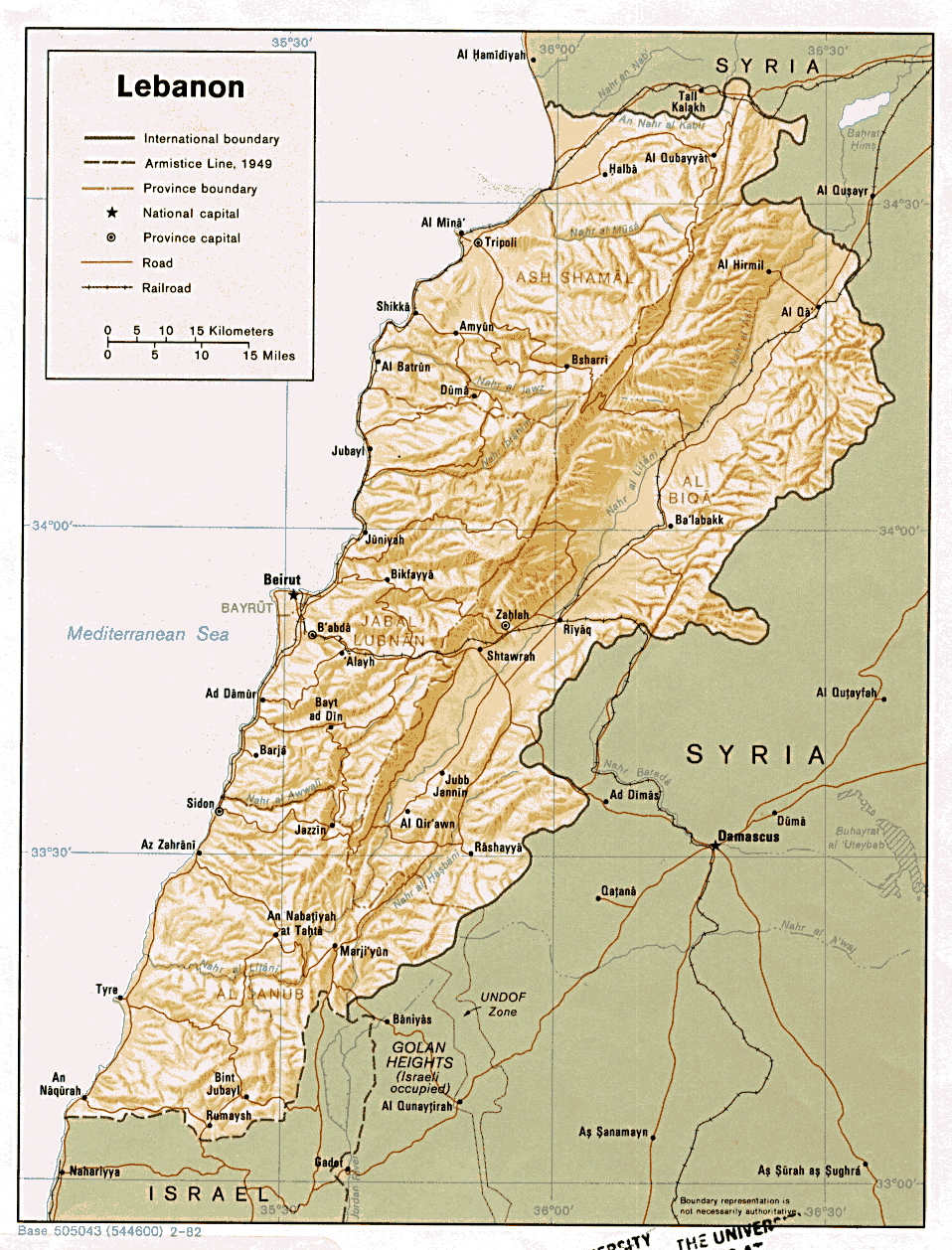
In the meantime there are reports that Syria is on increased alert due to the possibility of an Israeli attack. Saturday's attack along a Syria/Lebanon road was said by Israel to have been an attempt to prevent weapons smuggling, presumably from Syria into Lebanon.

Allegations that Bush may be urging an attack on Syria come on the heels of widely reported assertions by American conservatives and liberals that Bush had given Olmert a "green light" to attack Lebanon. The Jerusalem Post has supported Israel's right-wing Likud party and is considered to be "conservative" media. Are Israeli officials deliberately leaking information to a "friendly" news outlet? Or —is it classic Karl Rove disinformation? If so, it risks destabilizing a region that has clearly become a tinder box already. Sophomoric Rovian tactics risk inflaming what George Will had called a "cascading escalation". Is the Bush administration so ruthless that it will risk a World War III that can only result in the utter destruction of its participants?

The possibility that Bush may be urging such an attack is widely circulated now throughout the Middle East. Whether Bush is playing a disinformation game or, indeed, planning a proxy war against both Syria and Iran, it is a dangerous game with lethal consequences, possibly World War III. Another word describes it: madness!

In the meantime, CBS News reports more tanks and troops have pushed further into Lebanon as the Security Cabinet, made up of senior ministers, decided to broaden ground operations in a resumed offensive. The United Nations Security Council will debate a cease-fire resolution this week —but will it come in time?
Some updates:

Bush Wants Wider War

by Robert Parry

George W. Bush and his neoconservative advisers saw the conflict between Israel and Hezbollah as an opportunity to expand the conflict into Syria and possibly achieve a long-sought "regime change" in Damascus, but Israel's leadership balked at the scheme, according to Israeli sources.

One Israeli source said Bush's interest in spreading the war to Syria was considered "nuts" by some senior Israeli officials, although Prime Minister Ehud Olmert has generally shared Bush's hard-line strategy against Islamic militants.

After rebuffing Bush's suggestion about attacking Syria, the Israeli government settled on a strategy of mounting a major assault in southern Lebanon aimed at rooting out Hezbollah guerrillas who have been firing Katyusha rockets into northern Israel.

In an article on July 30, the Jerusalem Post hinted at the Israeli rejection of Bush's suggestion of a wider war in Syria. "Defense officials told the Post last week that they were receiving indications from the US that America would be interested in seeing Israel attack Syria," the newspaper reported.

On July 18, Consortiumnews.com reported that the Israel-Lebanon conflict had revived the Bush administration's neoconservative hopes that a new path had opened "to achieve a prized goal that otherwise appeared to be blocked for them – military assaults on Syria and Iran aimed at crippling those governments."

The article went on to say:

After the fall of Baghdad in April 2003 – after only three weeks of fighting – the question posed by some Bush administration officials was whether the U.S. military should go "left or right," to Syria or Iran. Some joked that "real men go to Tehran."

According to the neocon strategy, "regime change" in Syria and Iran, in turn, would undermine Hezbollah, the Shiite militia that controls much of southern Lebanon, and would strengthen Israel's hand in dictating peace terms to the Palestinians.

But the emergence of a powerful insurgency in Iraq – and a worsening situation for U.S. forces in Afghanistan – stilled the neoconservative dream of making George W. Bush a modern-day Alexander conquering the major cities of the Middle East, one after another.

Bush's invasion of Iraq also unwittingly enhanced the power of Iran's Shiite government by eliminating its chief counterweight, the Sunni regime of Saddam Hussein. With Iran's Shiite allies in control of the Iraqi government and a Shiite-led government also in Syria, the region's balance between the two rival Islamic sects was thrown out of whack.

The neocon dream of "regime change" in Syria and Iran never died, however. It stirred when Bush accused Syria of assisting Iraqi insurgents and when he insisted that Iran submit its nuclear research to strict international controls. The border conflict between Israel and Lebanon now has let Bush toughen his rhetoric again against Syria and Iran.

In an unguarded moment during the G-8 summit in Russia on July 17, Bush – speaking with his mouth full of food and annoyed by suggestions about United Nations peacekeepers – told British Prime Minister Tony Blair "what they need to do is get Syria to get Hezbollah to stop doing this shit."

Not realizing that a nearby microphone was turned on, Bush also complained about suggestions for a cease-fire and an international peacekeeping force. "We're not blaming Israel and we're not blaming the Lebanese government," Bush said, suggesting that the blame should fall on others, presumably Hezbollah, Syria and Iran.

Meanwhile, John Bolton, Bush's ambassador to the United Nations, suggested that the United States would only accept a multilateral U.N. force if it had the capacity to take on Hezbollah's backers in Syria and Iran.

"The real problem is Hezbollah," Bolton said. "Would it [a U.N. force] be empowered to deal with countries like Syria and Iran that support Hezbollah?" [NYT, July 18, 2006]

Strategy Meetings

Though the immediate conflict between Israel and Hezbollah was touched off by a Hezbollah cross-border raid on July 12 that captured two Israeli soldiers, the longer-term U.S.-Israeli strategy can be traced back to the May 23, 2006, meetings between Olmert and Bush in Washington.

At those meetings, Olmert discussed with Bush Israel's plans for revising its timetable for setting final border arrangements with the Palestinians, putting those plans on the back burner while moving the Iranian nuclear program to the front burner.

In effect, Olmert informed Bush that 2006 would be the year for stopping Iran's progress toward a nuclear bomb and 2007 would be the year for redrawing Israel's final borders. That schedule fit well with Bush's priorities, which may require some dramatic foreign policy success before the November congressional elections.

At a joint press conference with Bush on May 23, Olmert said "this is a moment of truth" for addressing Iran's alleged ambitions to build a nuclear bomb.

"The Iranian threat is not only a threat to Israel, it is a threat to the stability of the Middle East and the entire world," Olmert said. "The international community cannot tolerate a situation where a regime with a radical ideology and a long tradition of irresponsible conduct becomes a nuclear weapons state."

Olmert also said he was prepared to give the Palestinians some time to accept Israel's conditions for renewed negotiations on West Bank borders, but – if Palestinian officials didn't comply – Israel was prepared to act unilaterally.

The prime minister said Israel would "remove most of the [West Bank] settlements which are not part of the major Israeli population centers in Judea and Samaria. The settlements within the population centers would remain under Israeli control and become part of the state of Israel, as part of the final status agreement."

In other words, Israel would annex some of the most desirable parts of the West Bank regardless of Palestinian objections. That meant the Israelis would need to soften up Hamas, the Islamic militants who won the last Palestinian elections, and their supporters in the Islamic world – especially Hezbollah, Syria and Iran.

In a speech to a joint session of Congress, Olmert added that the possibility of Iran building a nuclear weapon was "an existential threat" to Israel, meaning that Israel believed its very existence was in danger.

Nuclear Face-Off

Even before the May 23 meetings, Bush was eyeing a confrontation with Iran as part of his revised strategy for remaking the Middle East. Bush was staring down Iran's hard-line President Mahmoud Ahmadinejad over demands Iran back off its nuclear research.

By spring 2006, Bush was reportedly weighing military options for bombing Iran's nuclear facilities. But the President encountered resistance from senior levels of the U.S. military, which feared the consequences, including the harm that might come to more than 130,000 U.S. troops bogged down in neighboring Iraq.

There was also alarm among U.S. generals over the White House resistance to removing tactical nuclear weapons as an option against Iran.

As investigative reporter Seymour Hersh wrote in The New Yorker, a number of senior U.S. officers were troubled by administration war planners who believed "bunker-busting" tactical nuclear weapons, known as B61-11s, were the only way to destroy Iran's nuclear facilities buried deep underground.

"Every other option, in the view of the nuclear weaponeers, would leave a gap," a former senior intelligence official told Hersh. "'Decisive' is the key word of the Air Force's planning. It's a tough decision. But we made it in Japan."

This former official said the White House refused to remove the nuclear option from the plans despite objections from the Joint Chiefs of Staff. "Whenever anybody tries to get it out, they're shouted down," the ex-official said. [New Yorker, April 17, 2006]

By late April, however, the Joint Chiefs finally got the White House to agree that using nuclear weapons to destroy Iran's uranium-enrichment plant at Natanz, less than 200 miles south of Tehran, was politically unacceptable, Hersh reported.

"Bush and Cheney were dead serious about the nuclear planning," one former senior intelligence official said.

But – even without the nuclear option – senior military officials still worried about a massive bombing campaign against Iran. Hersh wrote:

"Inside the Pentagon, senior commanders have increasingly challenged the President's plans, according to active-duty and retired officers and officials. The generals and admirals have told the Administration that the bombing campaign will probably not succeed in destroying Iran's nuclear program. They have also warned that an attack could lead to serious economic, political, and military consequences for the United States."

Hersh quoted a retired four-star general as saying, "The system is starting to sense the end of the road, and they don't want to be condemned by history. They want to be able to say, 'We stood up.' " [New Yorker, July 10, 2006]

The most immediate concern of U.S. military leaders was that air strikes against Iran could prompt retaliation against American troops in Iraq. U.S. military trainers would be especially vulnerable since they work within Iraqi military and police units dominated by Shiites who are sympathetic to Iran.

Iran also could respond to a bombing campaign by cutting off oil supplies, sending world oil prices soaring and throwing the world economy into chaos.

Israel's Arsenal

While the Joint Chiefs may have had success in getting the White House to remove the use of nuclear weapons from its list of options on Iran, the rising tensions between Israel and Iran may have put the nuclear option back on the table – since Israel has the largest and most sophisticated nuclear arsenal in the Middle East.

As Hersh reported, "The Israelis have insisted for years that Iran has a clandestine program to build a bomb, and will do so as soon as it can. Israeli officials have emphasized that their 'redline' is the moment Iran masters the nuclear fuel cycle, acquiring the technical ability to produce weapons-grade uranium."

In spring 2006, Iran announced that it had enriched uranium to the 3.6 percent level sufficient for nuclear energy but well below the 90-percent level for making atomic bombs. The U.S. intelligence community believes that Iran is still years and possibly a decade away from the capability of building a nuclear bomb.

Still, Iran's technological advance convinced some Israeli strategists that it was imperative to destroy Iran's program now. Yet to do so, Israel faces the same need for devastating explosive power, thus raising the specter again of using a nuclear bomb.

One interpretation of the Lebanese-Israeli conflict is that Bush and Olmert seized on the Hezbollah raid as a pretext for a pre-planned escalation that will lead to bombing campaigns against Syria and Iran, justified by their backing of Hezbollah.

In that view, Bush found himself stymied by U.S. military objections to targeting Iran's nuclear facilities outside any larger conflict. However, if the bombing of Iran develops as an outgrowth of a tit-for-tat expansion of a war in which Israel's existence is at stake, strikes against Iranian targets would be more palatable to the American public.

The end game would be U.S.-Israeli aerial strikes against Iran's nuclear facilities with the goal of crippling its nuclear program and humiliating Ahmadinejad.

Strangling an Axis

While U.S. officials have been careful not to link the Lebanon conflict to any possible military action against Iran's nuclear facilities, they have spoken privately about using the current conflict to counter growing Iranian influence.

Washington Post foreign policy analyst Robin Wright wrote that U.S. officials told her that "for the United States, the broader goal is to strangle the axis of Hezbollah, Hamas, Syria and Iran, which the Bush administration believes is pooling resources to change the strategic playing field in the Middle East. ...

"Whatever the outrage on the Arab streets, Washington believes it has strong behind-the-scenes support among key Arab leaders also nervous about the populist militants – with a tacit agreement that the timing is right to strike.

"'What is out there is concern among conservative Arab allies that there is a hegemonic Persian threat [running] through Damascus, through the southern suburbs of Beirut and to the Palestinians in Hamas,' said a senior U.S. official." [Washington Post, July 16, 2006]

Another school of thought holds that Iran may have encouraged the Hezbollah raid that sparked the Lebanese-Israeli conflict as a way to demonstrate the "asymmetrical warfare" that could be set in motion if the Bush administration attacks Iran.

But Hezbollah's firing of rockets as far as the port city of Haifa, deep inside Israel, has touched off new fears among Israelis and their allies about the danger of more powerful missiles carrying unconventional warheads, possibly hitting heavily populated areas, such as Tel Aviv.

That fear of missile attacks by Islamic extremists dedicated to Israel's destruction has caused Israel to start "dusting off it nukes," one source told me.

Originally published at www.consortiumnews.com

Robert Parry broke many of the Iran-Contra stories in the 1980s for the Associated Press and Newsweek. His latest book, Secrecy & Privilege: Rise of the Bush Dynasty from Watergate to Iraq, can be ordered at secrecyandprivilege.com. It's also available at Amazon.com, as is his 1999 book, Lost History: Contras, Cocaine, the Press & 'Project Truth.'

Were plans for a Middle East war escalation exposed in Bush-Blair exchange?

GlobalResearch.ca
A microphone unintentionally left open at the July 17, 2006 G-8 summit luncheon picked up snippets of unguarded talk between George Bush and Tony Blair. While most media coverage has focused on the embarrassing, stupid and profanity-laced portions of the comments uttered by Bush, a closer examination of the transcript confirms the multinational targeting of Syria and Syrian president Bashar Assad.

It also suggests that severe Anglo-American pressure, via the UN, will continue to be applied to Syria and Iran, both of which have been broadbrushed as the"terror masterminds behind Hamas and Hezbollah terrorists".

More than an idiot’s profanity

The worldwide media, Bush’s damage control apparatus, has spun the Bush-Blair exchange, in the most deceptive Bush-friendly manner. The New York Times spun it as a "blunt call for diplomacy", while another New York Times piece refers to "wise-guy Bush’s blunt and coarse chit-chat". Other headlines hailed the performance as "straight-talking Dubya", Bush "lets fly", "curses Hezbollah actions", "Bush urges Assad to end fighting", etc. All false.
First, Bush demonstrated what seasoned observers already know: Bush is a grotesque simpleton suffering from some mental afflication, who is also a ruthless intimidator wielding violence and power without intellect, and without regard. In short, a gangster. Gangsters do not need a great intellect to successfully conduct criminal activities, or head criminal empires. (In fact, intellect gets in the way.) Bush (and Cheney) routinely speaks using profanity. ...
A blockbuster from the Washington Post:

9/11 Panel Suspected Deception by Pentagon

Allegations Brought to Inspectors General
By Dan Eggen

Washington Post Staff Writer
Wednesday, August 2, 2006; Page A03Some staff members and commissioners of the Sept. 11 panel concluded that the Pentagon's initial story of how it reacted to the 2001 terrorist attacks may have been part of a deliberate effort to mislead the commission and the public rather than a reflection of the fog of events on that day, according to sources involved in the debate.
Suspicion of wrongdoing ran so deep that the 10-member commission, in a secret meeting at the end of its tenure in summer 2004, debated referring the matter to the Justice Department for criminal investigation, according to several commission sources. Staff members and some commissioners thought that e-mails and other evidence provided enough probable cause to believe that military and aviation officials violated the law by making false statements to Congress and to the commission, hoping to hide the bungled response to the hijackings, these sources said.
In the end, the panel agreed to a compromise, turning over the allegations to the inspectors general for the Defense and Transportation departments, who can make criminal referrals if they believe they are warranted, officials said.

"We to this day don't know why NORAD [the North American Aerospace Command] told us what they told us," said Thomas H. Kean, the former New Jersey Republican governor who led the commission. "It was just so far from the truth. . . . It's one of those loose ends that never got tied."
Although the commission's landmark report made it clear that the Defense Department's early versions of events on the day of the attacks were inaccurate, the revelation that it considered criminal referrals reveals how skeptically those reports were viewed by the panel and provides a glimpse of the tension between it and the Bush administration.

A Pentagon spokesman said yesterday that the inspector general's office will soon release a report addressing whether testimony delivered to the commission was "knowingly false." A separate report, delivered secretly to Congress in May 2005, blamed inaccuracies in part on problems with the way the Defense Department kept its records, according to a summary released yesterday. ...

Monday, July 31, 2006

Israeli Attacks Strengthen Hezbollah

Israel has taken the bait. The obvious targeting of civilians in Lebanon has only harmed Hezbollah —if at all —in a very superficial way. In the long, term Hezbollah is strengthened now that it can point to a credible Israeli threat to all of Lebanon.

As recently as April, 2005, Daniel Byman in Foreign Affairs wrote:

Most of Lebanon's ethnic and religious communities want Syria to leave, and even some Lebanese Shiites joined the recent anti-Syrian protests. Hezbollah has always tried to remain above Lebanon's communal fray, portraying itself as a resistance movement that transcends petty politics. But by opposing the cross-communal alliance against Syria, the Party of God has been undercutting its claims as a national organization.

...

Hezbollah can no longer use its anti-Israel campaign to win broad popular support.

—Daniel Byman, Hezbollah's Dilemma

Until now!

Byman pointed out that Hezbollah had enjoyed considerable popularity throughout Lebanon and that no Lebanese government was likely to bring Hezbollah to heel in the foreseeable future. Less so now! Hezbollah seems to be alone in its suprisingly stiff opposition to the Israeli incursion; it's position is, therefore, strengthened. With more to lose on this gamble, Israel is weakened.

Byman stated, in 2005, that "...U.S. attempts to compel an independent Lebanese government to crack down on the party would likely backfire. " Had anyone considered what kind of "backfire" might be caused by a disproportionate attack on Lebanon by Israel?

By 1985, Lebanon —the most peaceful of Mediterranean countries, the region's best hope for democracy —had become very nearly synonymous with war and violence. Beirut had been called the Paris of the Middle East. Israel's incursion into Lebanon was, we were told, intended to drive out the PLO. But, in that decade, Lebanon suffered a disproportionate share of death, violence and destruction —much more so than it its neighbors Syria and Israel. Mere numbers cannot begin to tell the complete story of Israel's occupation of Lebanon, an occupation of some 20 years, an occupation from which Lebanon was just recently recovering.

Some still hold out hope that Israel will withdraw. Some still hold out hope for peace even as conservatives talk of WWIII and, in the case of George Will on ABC, a "...cascading escalation". But, realistically, there is little hope for a quick return to even the reviled status quo ante short of some acknowledgment of the privations and destruction forced on Lebanon over a period of some 30 years.

Rice visited the war zone with double talk about status quo antes and false hopes of a "lasting peace" amid an on-going crisis. It is too much, therefore, to ask of the nations of the world that they rally behind Bush who lacks a plan to rally 'round.

It is not realistic to expect that Bush —who lied about Iraq in order to attack and invade that nation —can lead the Middle East out of its morass. Bombs and firepower are no substitute for moral authority.

It cannot be hoped, therefore, that Bush's regime can act as an honest broker in the Middle East. Nevertheless, the best hope for the avoidance of a larger war is that —despite Bush, despite Rice —the international community step up to the plate to urge Israel to acknowledge its civilian Lebanese victims.


The Existentialist Cowboy

Human Rights Watch: Israeli Air Attacks Called 'War Crimes'

More voices join a rising chorus: Israel is perpetrating war crimes by deliberately targeting civilians in Lebanon. The latest group to raise the issue is Human Rights Watch which recently documented similar charges against the Bush administration in Iraq. The organization joins Louise Arbour, United Nations High Commissioner for Human Rights, who said earlier that "...war crimes may have been committed in Lebanon" by Israel.

A New York-based human rights group says the Israeli military is fully responsible for its air strike that killed nearly 60 civilians in Lebanon, calling such attacks a "war crime."

In a statement released in Beirut Sunday, Human Rights Watch said Sunday's air strike in the village of Qana was a product of an indiscriminate bombing campaign amounting to a war crime.

The statement calls on the U.N. secretary-general to establish an International Commission of Inquiry to investigate violations of international humanitarian law during the conflict.

Meanwhile, the Organization of the Islamic Conference is preparing for an emergency meeting this week on the need for an immediate cease fire in the Middle East and deployment of a U.N. peace keeping force.

—VOA, Israeli Attacks [are] 'War Crimes'

UN Commissioner Arbour had warned that war crimes liability is not limited to military personnel; it applies equally to the politicians who decide, direct and approve military operations.

The specific international principles are the 1949 Geneva Conventions sought to prohibit, by international law, attacks which mainly target civilians. Article 51 of the First Protocol to the 1949 agreements (updated in 1977) states

Article 51: Protection of the Civilian Population
  • The civilian population and individual civilians shall enjoy general protection against dangers arising from military operations. To give effect to this protection, the following rules, which are additional to other applicable rules of international law, shall be observed in all circumstances.
  • The civilian population as such, as well as individual civilians, shall not be the object of attack. Acts or threats of violence the primary purpose of which is to spread terror among the civilian population are prohibited.
  • Civilians shall enjoy the protection afforded by this Section, unless and for such time as they take a direct part in hostilities.
  • Indiscriminate attacks are prohibited. Indiscriminate attacks are:

    • those which are not directed at a specific military objective;

    • those which employ a method or means of combat which cannot be directed at a specific military objective; or

    • those which employ a method or means of combat the effects of which cannot be limited as required by this Protocol; and consequently, in each such case, are of a nature to strike military objectives and civilians or civilian objects without distinction.

-Protocol 1 Additional to the Geneva Conventions, 1977

UN Commissioner Arbour is a former justice of Canada's Supreme Court and a chief prosecutor for the International Criminal Tribunals for Rwanda.

The Organization of the Islamic Conference [O.I.C] —an organization of Muslim-majority nations —will meet in an emergency, one-day session Thursday in Malaysia. The group will discuss an immediate cease fire and a U.N. deployment of peace keeping force.

A round up of the latest developments with regard to war crimes:

A War Crimes Tribunal May be the Only Deterrent to a Global War

The United Nations General Assembly must immediately establish an International Criminal Tribunal for Israel (ICTI) as a "subsidiary organ" under U.N. Charter Article 22. The ICTI would be organized along the lines of the International Criminal Tribunal for Yugoslavia (ICTY), which was established by the Security Council.

The purpose of the ICTI would be to investigate and prosecute Israeli war crimes, crimes against humanity and genocide against the Peoples of Lebanon and Palestine--just as the ICTY did for the victims of international crimes committed by Serbia and the Milosevic Regime throughout the Balkans.

The establishment of ICTI would provide some small degree of justice to the victims of Israeli war crimes, crimes against humanity and genocide against the Peoples of Lebanon and Palestine--just as the ICTY has done in the Balkans. Furthermore, the establishment of ICTI by the U.N. General Assembly would serve as a deterrent effect upon Israeli leaders such as Prime Minister Olmert, Defense Minister Peretz, Chief of Staff Halutz and Israel's other top generals that they will be prosecuted for their further infliction of international crimes upon the Lebanese and the Palestinians.

Without such a deterrent, Israel might be emboldened to attack Syria with the full support of the Likhudnik Bush Jr. Neoconservatives, who have always viewed Syria as "low-hanging fruit" ready to be taken out by means of their joint aggression.

The Israeli press has just reported that the Bush Jr administration is encouraging Israel to attack Syria. If Israel attacks Syria as it did when it invaded Lebanon in 1982, Iran has vowed to come to Syria's defense.

And of course Israel and the Bush Jr administration very much want a pretext to attack Iran. This scenario could readily degenerate into World War III.

...

How can 'terrorism' be condemned while war crimes go without rebuke?

Washington's partners in this hypocritical war on terror are given free rein to wreak their own brutal, illegal violence

David Clark
Monday July 31, 2006
The Guardian

As if we didn't know it already, the conflict in Lebanon shows that truth and war don't mix. All parties to the tragedy of the Middle East resort to disinformation and historical falsification to bolster their case, but rarely has an attempt to rewrite the past occurred so soon after the fact. Israeli ministers and their supporters have justified the bombardment of Lebanon as "a matter of survival". Total war has been declared on Israel, so Israel is entitled to use the methods of total war in self-defence. This would be reasonable if it were true, but it isn't. It's completely false. ...

Lebanon alleges war crimes

Published: Monday, 31 July, 2006, 12:53 PM Doha Time

BEIRUT: The Lebanese government yesterday accused Israel of war crimes and crimes against humanity following the deadly raid on the village of Qana, saying the US was covering up the Jewish state’s attacks on the country.

"These aggressions are crimes against humanity and war crimes in all senses of the words," Information Minister Ghazi Aridi said, reading a statement after an emergency cabinet session.

"It is to hide their failure in achieving their military objectives," he said.

Asked about the US position concerning the continued Israeli attacks on Lebanon, Aridi said Washington "is covering up these aggressions."

Qana, War Crimes, and the Pending UN Resolution on Lebanon

JURIST Guest Columnist Anthony D'Amato of Northwestern University School of Law says that the Israeli air strike on Qana that killed over 60 Lebanese civilians has set the stage not only for possible war crimes prosecutions but also for a potentially-robust UN Security Council resolution imposing a UN peacekeeping force on the parties in an effort to stop the violence...

Secretary of State Condoleezza Rice was meeting with Israeli Defense Minister Amir Peretz in Jerusalem on Sunday morning July 30th when news came in of a two-missile strike on a house in Qana, Lebanon. So far, over 60 bodies of civilians have been recovered, the majority of them children. A father of five who managed to escape lost his wife, sister, aunt, and all his children, including a two-year-old. The pinpoint accuracy of the Israeli missiles is not disputed. ...


The Existentialist Cowboy

Sunday, July 30, 2006

US middle east policy: "...a blood soaked failure"!

Israel targets Hezbollah but kills primarily civilians and UN observers. To call it "Unintended consequences" is polite. To liken it to Bush's strategy in Iraq is more accurate. Things fall apart; the center cannot hold; mere chaos is loosed upon the world.

Things are so bad for Bush that only a catastrophe —Israel's disproportionate and tragic invasion of Lebanon —could knock Iraq, where some 100 civilians are slaughtered daily, off the front pages. If Bush thought a respite from bad Iraq news would help, he is sorely disappointed. A majority of Americans think the nation is on the "wrong track" and the fact that he is seen has having given Ehud Olmert a "green light" does not help his case. [See: Israeli Strike Kills 54]

While the world watches what George Will has called an "cascading escalation" in the middle east, Iraq itself disintegrates. "Operation Together Forward" —a joint Iraqi-U.S. military operation to restore security in Baghdad —is described by The Register Guard as "...a blood-soaked failure." There is even talk of an impending coup d'etat in Iraq. If Iraqi Prime Minister Nouri al-Maliki's Shi'ite majority cannot rule Iraq, then what is to be said of the prospects for Democracy? What is to be said of Bush's rhetoric? But most significant: what is to be said of the many lies told by Bush to start the war to begin with?

There is also talk of a US backed Kurdish minority even as Sunnis take control of Baghdad. But I wonder how the Kurds —betrayed by Bush Sr —will be fooled again. Clearly —Bush never had a plan beyond bombing, attacking, invading and blowing up stuff. Quagmires, I suppose, are to heal themselves. Meanwhile, on ABC This Week, Fareed Zacharias suggested that the US is left with but one option: threatening Iraq with a withdrawal!

That bears repeating: the US presence in Iraq is such a debacle, such an utter failure, that the US —the chest-beating last remaining superpower —is reduced to threatening to withdraw. Perhaps Israel should similarly threaten Lebanon! It may be the only way left to win.

In the meantime, according to a CBS News/New York Times Poll, 62 percent of all Americans, 60 percent of all independents, and 89 percent of all Democrats disapprove of Bush's handling of Iraq.

It's tempting to attribute some of that to Bush's dubious achievements in the Middle East:

  • The Bush administration has ensured that the international community will fail to stop the mayhem in Lebanon by raising the bar, false hopes, and unrealistic expectations. Now, rather, is the time for practical solutions to an immediate crisis.
  • The US has ceased to play its traditional role of "honest broker"; instead, the Bush administration arms but one side of the dispute with sophisticated rockets and powerful bombs

It's time to face the fact that Bush policies, and likewise, the policies of Ehud Olmert in Israel, are counter-productive. A couple of points:

  • Hezbollah didn't exist before Israel invaded Lebanon during the Reagan years.
  • Bush foot dragging and unrealistic insistence upon a "lasting peace" has allowed Israel enough time to devastate Lebanon though it claims Hezbollah is its target.
Israel publicly proclaims that its goal is nothing less than the complete dismantling of Hezbollah's military infrastructure —"once and for all". Aside from the fact that an air campaign alone cannot accomplish this, disillusioned millions, radicalized by the disproportionate nature of the attack in the first place, will most certainly emerge stronger and more radical. Even if Israel should succeed in crippling Hezbollah —the maximum achievable by an air campaign —a stronger, more radical party will emerge on the other side.

Nor can Hezbollah be "dismantled" by an armed invasion. Now that the hoped for cease fire has fallen apart, it is difficult to see how an emerging pattern of escalation —feeding upon its own momentum —will stop short of a disastrous march into Beirut. This option will only result in murderous urban, guerrilla warfare.

It will not render Hezbollah powerless, because it is simply impossible to eliminate thousands of small, mobile, hidden and easily resupplied rockets via an air campaign. And it will not lead the weak Lebanese government to confront Hezbollah, because the civilian casualties caused by Israel's bombing are infuriating the Lebanese population and providing fodder for Israel's enemies throughout the Muslim world.

—Philip H. Gordon, Brookings Institution

Israel should know better; it's been there before. In 1982, Israeli soldiers were greeted with flowers and candy. But the purpose then was to kick out PLO occupiers. But —alas —Israel became the occupier of Lebanon and stayed for some 18 years.

If the world is lucky, Israel will have learned a lesson and settle for something less than full victory which they've defined as the utter destruction of Hezbollah. Hezbollah, however, wins if it only thwarts Israeli objectives.

A by-product of this war has been the increasingly alarmist vocabulary even among conservative commentators. George Will —a conservative —compared the "cascading escalation" to the events which followed the killing of Archduke Ferdinand in Sarajevo in 1914.


The Existentialist Cowboy

Tuesday, July 25, 2006

How George Bush Became a Dictator

An existential choice is forced upon us. Bush told us that we were either for his regime or we were for the "evil doers". I see a different paradigm: either we are for freedom or we are for Bush. Bush is spoiling for a Constitutional showdown that will force the issue and consolidate a dictatorship beyond the ability of Americans to change –short of violent revolution.

In his latest book "Conservatives Without Conscience", John Dean paints a stark difference between Richard Nixon and George Bush. Dean recalled the day the Supreme Court ordered Nixon to hand over the infamous White House tapes. Nixon, Dean reveals, toyed with the idea of defying the high court. It was Nixon, after all, who had said that if the President does it, it's legal.

Pressured by his own party, Nixon spent a night talking to portraits and getting down on his knees in prayer with an embarrassed Henry Kissinger. By night's end, as the story goes, Nixon had had an epiphany. He would resign.

What brought him to a night of prayer was his decision to comply with an order of the US Supreme Court to turn over the secret recordings of his Oval Office conversations. They were notable for what was missing: an 18 minute gap, and also what was present: a tape recorded "smoking gun" in which then White House Counsel John Dean had warned Nixon of a "cancer on the Presidency".

But, Bush —Dean points out —is not Nixon. In the same or a similar situation, Bush will not budge. Bush will defy the Supreme Court of the United States. In doing so, America will no longer have the legal recourse of removal; impeachment will be a dead issue. If impeached, Bush will not leave the office. Having subverted every protection afforded the people by our founders, Bush will leave us no choice but slavery under a dictatorship or a popular uprising. Bush will leave us, therefore, no choice but revolution.
...whenever any Form of Government becomes destructive of these ends, it is the Right of the People to alter or to abolish it, and to institute new Government.

—Thomas Jefferson, Declaration of Independence
Nixon was called an "imperial President". Interestingly, the articles of impeachment against Richard Nixon were concerned with his abuse of the IRS, obstruction of justice in connection with the Watergate Scandal, and his various abuses of agencies to include the CIA. His secret bombing of Cambodia is not mentioned in the articles of impeachment against him. Nevertheless, Nixon's downfall is most certainly traced to hubris and disproportionate power invested in the modern Presidency.

Bush seems to have created a dictatorship by exploiting a national tragedy, by manipulating a wave of fear, by fanning the flames of racial and religious prejudice. He divided the world into two opposing camps: us and "evil-doers" and declared that if you disagreed with him, then you, too, were an "evil doer". Declaring that he did not do nuance, Bush made of stupidity a virtue.

He suppressed dissent and declared himself above the law. He declared that he could interpret even the rulings of the Supreme Court; he could pick and choose which portions of laws he might enforce and which portions he might ignore; he assumed the additional powers of the judiciary and the legislature. He dared anyone to stop him. "Who cares what you think?" he asked.
He tipped his hand: "This would be a whole lot easier if this was a dictatorship ...just has long as I'm the dictator". If he, in fact, did not say "...stop throwing the Constitution up to me! The Constitution is just a goddamned piece of paper", he might as well have. His attitude and his actions are most certainly consistent with it.

When he was always wrong, he got support from a "liberal" media. What does being right have to do with anything? asked Thom Friedman. The GOP —Bushco in particular —is not restrained by common sense, concepts of good and bad, right and wrong.
Republicans appreciate that they are more likely to maintain influence and control of the presidency if the nation remains under ever-increasing threats of terrorism, so they have no hesitation in pursuing policies that can provoke potential terrorists throughout the world.

—John Dean, Conservatives Without Conscience
Dean's book is widely reviewed as a study of the insidious nature of the conservative mentality. It is that to be sure but it is more importantly, a study of how that mentality is leading us inexorably to dictatorship. Dean cites the work of Bob Altemeyer of the University of Manitoba whose 1981 book Right Wing Authoritarianism may have diagnosed the Bushco pathology.
Even the members of authoritarian groups appear to have changed during the '80s. The steely-eyed fanatic wearing a Nazi uniform and marching in Marquette Park (clearly one of "them") has been joined by the neatly dressed middle-class housewife throwing blood on abortion facilities. These authoritarian characters are so ordinary they could even be one of "us."

—Right Wing Authoritarianism
Defined by symptoms identified by Altermyer and Dean, Bush's authoritarian dictatorship may have ushered in a new era in which states wage war not against other states but against civilian populations. Bush's war against Iraq, for example, is unlike previous wars; his goals are chaos, death, and annihilation. Bush was not only wrong about Iraq, it is clear that he deliberately lied about WMD in particular.
Our intelligence officials estimate that Saddam Hussein had the materials to produce as much as 500 tons of sarin, mustard and VX nerve agent. In such quantities, these chemical agents could also kill untold thousands. He's not accounted for these materials. He has given no evidence that he has destroyed them. U.S. intelligence indicates that Saddam Hussein had upwards of 30,000 munitions capable of delivering chemical agents. Inspectors recently turned up 16 of them -- despite Iraq's recent declaration denying their existence. Saddam Hussein has not accounted for the remaining 29,984 of these prohibited munitions. He's given no evidence that he has destroyed them.

From three Iraqi defectors we know that Iraq, in the late 1990s, had several mobile biological weapons labs. These are designed to produce germ warfare agents, and can be moved from place to a place to evade inspectors. Saddam Hussein has not disclosed these facilities. He's given no evidence that he has destroyed them.
The International Atomic Energy Agency confirmed in the 1990s that Saddam Hussein had an advanced nuclear weapons development program, had a design for a nuclear weapon and was working on five different methods of enriching uranium for a bomb.

The British government has learned that Saddam Hussein recently sought significant quantities of uranium from Africa. Our intelligence sources tell us that he has attempted to purchase high-strength aluminum tubes suitable for nuclear weapons production. Saddam Hussein has not credibly explained these activities. He clearly has much to hide.

—George W. Bush, State of the Union Address, 2003
When nothing said by Bush turned out to have been true, Dean followed up with an article that asked Is lying about the reason for a war an impeachable offense?
To put it bluntly, if Bush has taken Congress and the nation into war based on bogus information, he is cooked. Manipulation or deliberate misuse of national security intelligence data, if proven, could be "a high crime" under the Constitution's impeachment clause. It would also be a violation of federal criminal law, including the broad federal anti-conspiracy statute, which renders it a felony "to defraud the United States, or any agency thereof in any manner or for any purpose."

—John Dean, Is lying about the reason for a war an impeachable offense?
The Iraq war —now a debacle of unimaginable proportions —turned out to have been sold with a deliberate hoax. Colin Powell's presentation to the UN consisted of fabricated evidence, out of date satellite photos, bogus information by compromised informants, and, most notoriously, a plagiarized student paper. In fact, not getting the information he wanted to hear, Donald Rumsfeld created an Office for Special Plans tasked with telling him what he wanted to hear. The authoritarian diagnosis explains why it no longer matters to modern American conservatives that nothing mitigates the American occupation of Iraq —a grand theft begun upon a world wide hoax turned debacle.

More recently, the Israeli bombardment of Lebanon —a Bush battle by proxy —is just such a case. While there is still the possibility that Iran and Syria will ally and join the fray, Bush will only exploit that as well. An authoritarian dictatorship, Bush's stock and trade, is fear; being "right" does not matter. Clearly —Bush has never shown himself to be concerned with consequences. What does matter to Bush is that Iraq is now off the front pages and just in time for the mid-terms.

How did we get from there to here? How was our Democracy snatched from under our noses? How did we wake up as cockroaches?

It may have begun with the passage of the National Security Act of 1947 [NSC-68]. It was then that the United States became a "security state”. The act was implemented in January 1950 when the National Security Council produced a blueprint for a new kind of country, unlike anything that preceded World War II.

It was not openly discussed at the time, but Senator Arthur Vandenburg —a Republican —reportedly told Truman "...that if he really wanted all those weapons and all those high taxes to pay for them, he had better 'scare the hell out of the American people.'"

It would appear that Bush took that admonition to heart. But the issue with Bush and Reagan had not and is not a matter of finding ways to pay for high tech ways to blow things up, it's a matter of simply not paying for them at all —hence the Reagan/Bush deficits! Reagan left to Bush Sr the largest debt in our nation's history. Bush will do the same if he leaves office.

In the meantime, a climate of fear is maintained. The brief exception is Dwight Eisenhower. In an attack of conscience unheard of among latter day Republicans, Eisenhower warned against the military-industrial complex that had, by then, established permanent control over the state! We've been overfeeding the beast since 1947.

It was David Hume’s 1758 Of the First Principles of Government that stated:
Nothing appears more surprising to those who consider human affairs with a philosophical eye than the easiness with which the many are governed by the few, and the implicit submission with which men resign their own sentiments and passions to those of their rulers.

When we inquire by what means this wonder is effected, we shall find that, as force is always on the side of the governed, the governors have nothing to support them but opinion. It is, therefore, on opinion only that government is founded, and this maxim extends to the most despotic and most military governments as well as to the most free and most popular.

—David Hume, Of the First Principles of Government
Hume was most certainly not alone in associating military governments with despotic governments. When any person puts himself both above and against the law, then the people of the US states are entitled lawfully to rise up —violently if necessary —to overthrow the tyrant, the self-proclaimed dictator.

John Dean makes this chilling point. Nixon, as we mentioned earlier, toyed with the idea of defying the high court, but, in the end thought better of it and resigned. Bush/Cheney won't budge. They have already declared that whatever may be alleged against them, they can, themselves "authorize" it and make legal –even after the fact. Bush has arrogated unto himself the power to interpret the laws. In a crisis, Bush will defy the court and the American republic is over.

Both Jefferson and Che Guevarra recognized that when government reaches this point, it operates outside the law. Both men recognized the terrible alternative to ultimate submission to tyranny. Revolution!

The success of revolution is by no means guaranteed. Lives will be lost; a terrible cost will be exacted. Victory is not cheap but the cost of failure is even more dear: our freedom. It is the existentialist position that we are most truly human in our acts of choice. Sartre said, for example, that “….man is nothing else but what he makes of himself.’ These are not empty words; consider the dreadful implications of making the wrong choice, but even worse, no choice. It is not so much the choice we make between a predetermined good vs a predetermined evil that is significant but, rather, the fact that we make a choice at all. Even Victor Frankl, inside the concentration camp, found his humanity in exercising the last choice left him: that of his own attitude. When Bush has denied us Democracy, we may either submit and be slaves, or choose freedom and fight.

From a review of this article:
This is an interesting commentary that discusses a lot of what Dean talks about in his new book, Conservatives Without Conscience.

I often use Nixon's decision to turn over the tapes as an example of how Nixon helped us avoid a disasterous constitutional crisis.

What if Nixon had continued to defy the SCOTUS order to turn over the tapes? What if Nixon just kept saying, "nope, you can't have them."?

Just who would have enforced the Supreme's decision?

When I ask my students this question, I get the usual answers:

The FBI. Nope they work for the president.
The Attorney General? Nope they work for the president.
The military? Nope, the president is the commander-in-chief.
The Washington D.C. police? Nope, not their jurisdiction.

The answer is, no one knows what would have happened. We do know that since all of the enforcers work for the president, it is unlikely that Nixon would have ordered any of the people under him to enforce an order by the Court that he was actively defying.

Nixon did us a huge favor when he changed his mind about not turning over the tapes and resigned. Nixon wasn't stupid. I think he realized the crisis that the nation was facing.

I just don't think Bush is smart enough about how our government works to understand something like this. And, if he does, he obviously doesn't care.

—Momwolf's Friends Page

Jonathan Schell has written an excellent analysis of the Bush dictatorship that will appear in The Nation —but we get a free preview here:

The US: Too late for empire

By Jonathan Schell

There is a large body of observations that at one and the same time have been made too often and yet not often enough - too often because they have been repeated to the point of tedium for a minority ready to listen, but not often enough because the general public has yet to consider them seriously enough.

...

President George W Bush sent US troops into Iraq to find weapons of mass destruction (WMD), but they weren't there. He said Saddam Hussein's regime had given help to al-Qaeda, but it had not.

He therefore took the nation to war on the basis of falsehoods.

His administration says the torture at Abu Ghraib prison in Iraq and elsewhere has been the work of a few bad apples in the military, whereas in fact abuses were sanctioned at the highest levels of the executive branch in secret memos.

His administration lambastes leakers, but its own officials illegally leaked the name of a Central Intelligence Agency operative, Valerie Plame, to discredit her husband politically.

He flatly stated to the public that all wiretaps of Americans were ordered pursuant to court warrants, whereas in fact he was authorizing and repeatedly reauthorizing warrantless wiretaps. These wiretaps violated a specific law of Congress forbidding them.

His administration has asserted a right to imprison Americans as well as foreigners indefinitely without the habeas corpus hearings required by law.

Wars of aggression, torture, domestic spying and arbitrary arrest are the hallmarks of dictatorship, yet Congress, run by the president's party, has refused to conduct full investigations into either the false WMD claims, or the abuses and torture, or the warrantless wiretaps, or the imprisonment without habeas corpus.

When Congress passed a bill forbidding torture and the president signed it, he added a "signing statement" implying a right to disregard its provisions when they conflicted with his interpretation of his powers.

The president's secret legal memos justifying the abuses and torture are based on a conception of the powers of the executive that gives him carte blanche to disregard specific statutes as well as international law in the exercise of self-granted powers to the commander-in-chief nowhere mentioned in the constitution.

If accepted, these claims would fundamentally alter the structure of the US government, upsetting the system of checks and balances and nullifying fundamental liberties, including guarantees in the Fourth Amendment to the constitution against unreasonable searches and seizures and guarantees of due process. As such, they embody apparent failures of the president to carry out his oath to "preserve, protect and defend the constitution of the United States". ...

—Jonathan Schell, The US: Too late for empire

When did America STOP being the "good guys"?

Aussie veto stopped US war crimes

Cameron Stewart

July 29, 2006
29jul-mcnarn

Brigadier Maurie McNarn

AUSTRALIA intervened to stop key US military strikes against Saddam Hussein's regime in Iraq, fearing they might constitute a war crime.

Major General Maurie McNarn, then a brigadier and commander of Australian forces in Iraq, on several occasions played a "red card" against the American plans, which included hits on individuals. His objections drew anger from some senior US military figures.

In one instance, Major General McNarn vetoed a US plan to drop a range of huge non-precision bombs on Baghdad, causing one angry US Air Force general to call the Australian a "pencil dick".

However, US military command accepted Major General McNarn's objection and the US plans were scrapped. ...


The Existentialist Cowboy

Sunday, July 23, 2006

Human Rights Watch: Bush Administration Lied About Torture; it's widespread, endemic, and goes right up the chain of command

In a 53-page report, “No Blood, No Foul: Soldiers’ Accounts of Detainee Abuse in Iraq,” US soldiers reveal that contrary to previous statements by the Bush administration, detainees were routinely beaten, put in stressful positions, deprived of sleep and exposed to hot and cold extremes. Human Rights Watch bases its report on interviews, memoranda and sworn statements.

The report, consists of first-hand accounts by U.S. military personnel and provide details of detainee abuses that are at odds with previous statements by the Bush administration. The official program of torture took place at "...an off-limits facility at Baghdad airport and at other detention centers throughout Iraq." Soldier accounts allege that abusive techniques "...were authorized by the military chain of command". This directly contradicts various Pentagon statements and cover stories. It directly refutes the "few bad apples" defense.

The report is consistent with widely reported efforts by the Bush Justice Department to find legal justification for torture even as various administration officials were denying that it had taken place or that it was widespread.

Soldiers were told that the Geneva Conventions did not apply, and that interrogators could use abusive techniques to get detainees to talk. These accounts rebut U.S. government claims that torture and abuse in Iraq was unauthorized and exceptional – on the contrary, it was condoned and commonly used.”

—John Sifton, the author of the report and the senior researcher on terrorism and counterterrorism at Human Rights Watch.

From the report:
Many of the crimes detailed in this report are violations of international humanitarian law, U.S. military law, and U.S. federal criminal law. The U.S. government’s failure to properly investigate these violations is an affront to the victims of the abuses, and a violation of U.S. obligations under the Geneva Conventions, which obligate states to prosecute serious violations of the conventions’ provisions (“grave breaches”).

The accounts in this report are further evidence that detainee abuse was an established and apparently authorized part of detention and interrogation processes in Iraq for much of 2003-2005. The cases also show that U.S. military personnel have faced systemic obstacles to reporting or exposing abuses, that the U.S. military in numerous cases has not taken adequate measures to stop reported abuses. The report also shows that the U.S. military has often failed to properly investigate and prosecute perpetrators, including officers who allowed abuses to occur on their watch.

—Conclusions, No Blood, No Foul, Soldiers’ Accounts of Detainee Abuse in Iraq, Human Rights Watch

Serious abuses are associated with a special task forces —Task Force 20, Task Force 121, Task Force 6-26, and Task Force 145 — which was stationed at an off-limits detention center at the Baghdad airport, called Camp Nama. Other incidents referred to include facilities near Mosul airport, and a base near al-Qaim, on the Syrian border.

George Bush has repeatedly insisted, "We do not torture." Secretary of State Condoleeza Rice has repeatedly claimed that the United States does not engage in "cruel, inhuman, or degrading treatment. And CIA Director Porter Goss affirms that his agency "does not do torture. Torture does not work." But no one believes the BUsh administration on this issue and for good reason.

—John Dean, Conservatives Without Conscience

Dean goes on to point out that the Bush administration had coaxed the Justice Department into re-defining torture out of existence. Meanwhile, the Economist disounted Bushco's absurd claims that if the President authorized it, it is legal —and his equally absurd claim that the US is not bound to the Geneva Conventions.

Since then, of course, the Supreme Court dealt the Bush rationale a death blow. By a vote of 5-3 SCOTUS, in 'Hamdan v. Rumsfeld', ruled that Bush overstepped his authority when he ordered military tribunals for Guantanamo detainees. The administration had claimed that the detainees were not entitled to Geneva protections because they were not prisoners of war. This is, of course, another inconsitency in Bush's position. We are told we are at war, yet "prisoners" taken in that war are not "prisoners of war". If they are not, then we are not at war.

In the majority opinion, Justice John Paul Stevens forcefully rejected the Bush argument, writing:

Congress has not issued the executive a 'blank check,"' [adding:] "Indeed, Congress has denied the president the legislative authority to create military commissions of the kind at issue here.
Bush had claimed that the US was not bound by Geneva at all. Clearly —that is not the case. The US is, in fact, bound to International Law as well as U.S. "...laws prohibiting torture and other ill-treatment of any person in custody in all circumstances." Human Rights Watch states that the
"...prohibition[s] apply to the United States during times of peace, armed conflict, or a state of emergency. Any person, whether a U.S. national or a non-citizen, is protected. It is irrelevant whether the detainee is determined to be a prisoner-of-war, a protected person, or a so-called “security detainee” or “unlawful combatant.”
In other words, prohibitions against torture and ill-treatment of prisoners are absolute despite Bush's various efforts to re-define torture and to make legal, after the fact, the crimes that he's already committed.


The Existentialist Cowboy

Saturday, July 22, 2006

Israel Commits War Crimes in Lebanon

Louise Arbour, United Nations High Commissioner for Human Rights, says that "...war crimes may have been committed in Lebanon" by Israel. Her comments clearly target Tel Aviv, warning that war crimes liability is not limited to military personnel; it applies equally to the politicians who decide, direct and approve military operations.

In my opinion, there is no reason to exempt either Israel in Lebanon or the US in Iraq from liability. Her warning, therefore, was most certainly heard in Israel by backers in the Bush administration and the British government of Tony Blair. One hopes her words will resonate among people of goodwill throughout the world.

According to the BBC, Ms. Arbour is a former justice of Canada's Supreme Court. She was a chief prosecutor for the International Criminal Tribunals for Rwanda and the former Yugoslavia, indicted the former Yugoslav president Slobodan Milosevic. "

International humanitarian law is clear on the supreme obligations to protect civilians during hostilities

-Louise Arbor, United Nations High Commissioner for Human Rights

She says that the same obligation exists in international criminal law, which defines war crimes and crimes against humanity. It is my position that these principles, likewise, apply to George W. Bush and various members of his administration with regard to the attack, the invasion, and the disastrous, illegal occupation of Iraq.

Arbour stresses the "supreme obligation" of states to protect civilians and refers to the "scale of killings" in Lebanon, where the Israeli reaction is clearly seen to have been massive and disproportionate. The 1949 Geneva Conventions sought to prohibit, by international law, attacks which mainly targeted civilians as the Israeli bombardment seems to have done. Article 51 of the First Protocol to the 1949 agreements (updated in 1977) states:

Article 51: Protection of the Civilian Population
  • The civilian population and individual civilians shall enjoy general protection against dangers arising from military operations. To give effect to this protection, the following rules, which are additional to other applicable rules of international law, shall be observed in all circumstances.
  • The civilian population as such, as well as individual civilians, shall not be the object of attack. Acts or threats of violence the primary purpose of which is to spread terror among the civilian population are prohibited.
  • Civilians shall enjoy the protection afforded by this Section, unless and for such time as they take a direct part in hostilities.
  • Indiscriminate attacks are prohibited. Indiscriminate attacks are:

  • those which are not directed at a specific military objective;
  • those which employ a method or means of combat which cannot be directed at a specific military objective; or
  • those which employ a method or means of combat the effects of which cannot be limited as required by this Protocol; and consequently, in each such case, are of a nature to strike military objectives and civilians or civilian objects without distinction.
  • -Protocol 1 Additional to the Geneva Conventions, 1977

    Article 52 adds: "Attacks shall be limited strictly to military objectives..." Therefore, there is a war crime if civilians are specifically attacked as civilians. However, it is different if they are killed as a result of a strike against a military or a "dual-use" target. More about that in a moment.

    I venture to say that there is no reason to believe hat the government of Ehud Olmert has taken prudent measures to reduce civilian causalities. So far, Lebanese deaths have topped 300. In a mounting humanitarian crisis some 700,000 Lebanese civilians have become displaced refugees -by some estimates about 1/7 of the entire population. The reality on the ground is thus summed up: the entire nation of Lebanon is under attack and faces utter destruction of infrastructure and basic services.

    In the meantime, Robert Fisk notes the significant difference between the "pin-point accuracy" of Israeli technology on the attack and the antiquated Hezbollah defense. Israel can and does target precisely. If civilian targets are disproportionately destroyed, it would appear to be by design. In other words, Israel can -if it wishes -avoid the mass murder of innocent civilians. But as Fisk points out: "...they continue to fill Lebanon's body bags with infants, women and children." At what point does deliberate targeting become "ethnic cleansing". Chillingly, Israel's prosecution of these attacks bears an increasing resemblance to the systematic destruction of the Warsaw Ghetto by Nazis in World War II.

    This is a war crime! The American people must demand of our illegitimate Bush administration that we join the rest of the entire world in demanding an immediate cease fire.

    Aside from US culpability in Iraq, the US -Israel's top ally -has obstructed a cease fire. Condoleeza Rice resorted to double talk about the status quo and, even here, she is wrong. Holding out hopes of a lasting but unlikely peace, her words are but a red herring -indeed, it is Rice who holds out the mirage, the "false promise" of "lasting peace". A status quote ante is preferable to the ongoing slaughter. Her "talks", therefore, are doomed to failure. One cynically suspects, that the Bush administration knows this full well. It is increasingly difficult not to believe that Condoleeza Rice has departed for the Middle East to "negotiate" in bad faith. It is also difficult not to believe that this cynical administration deliberately seeks to exploit this issue to split the "progressive" movement.

    An update and commentary from the Washington Post:

    Hunker Down With History

    By Richard Cohen
    Tuesday, July 18, 2006; Page A19

    The greatest mistake Israel could make at the moment is to forget that Israel itself is a mistake. It is an honest mistake, a well-intentioned mistake, a mistake for which no one is culpable, but the idea of creating a nation of European Jews in an area of Arab Muslims (and some Christians) has produced a century of warfare and terrorism of the sort we are seeing now. Israel fights Hezbollah in the north and Hamas in the south, but its most formidable enemy is history itself.

    This is why the Israeli-Arab war, now transformed into the Israeli-Muslim war (Iran is not an Arab state), persists and widens. It is why the conflict mutates and festers. It is why Israel is now fighting an organization, Hezbollah, that did not exist 30 years ago and why Hezbollah is being supported by a nation, Iran, that was once a tacit ally of Israel's. The underlying, subterranean hatred of the Jewish state in the Islamic world just keeps bubbling to the surface. The leaders of Saudi Arabia, Egypt, Jordan and some other Arab countries may condemn Hezbollah, but I doubt the proverbial man in their street shares that view. ...

    An update from Maureen Dowd:

    Condi doesn't want to talk to Hezbollah or its sponsors, Syria and Iran — "Syria knows what it needs to do," she says with asperity — and she doesn't want a cease-fire. She wants "a sustainable cease-fire," which means she wants to give the Israelis more time to decimate Hezbollah bunkers with the precision-guided bombs that the Bush administration is racing to deliver.


    The Existentialist Cowboy

    Wednesday, July 19, 2006

    Bush plays politics with human life

    George Bush has made yet another bad choice. He has chosen to play politics with human life. He has chosen to deny hope to millions of Americans who suffer from debilitating diseases, millions for whom stem cell research represented their best chance of cure or a better quality of life. Bush's bad decision will be applauded by a minority of Americans who disingenuously call their movement: "right to life". For the life of me, I can't see how condemning millions of Americans to an early death has anything to do with the "right to life".

    This was the first time Bush has used the veto and that he chose this bill will define his failed presidency as much as his failed war of aggression in Iraq where, likewise, the civilian death toll is the anti-thesis of "right to life". Our very presence in Iraq, Bush's policy of torture, the rising civilian death toll at the hands of frustrated US troops proves the lie to "right to life".

    Bush's veto may very well bring about an end to research that might have led to new cures for juvenile diabetes, leukemia, Parkinson's, Alzheimer's, and many others. That 70% of Americans disagree with Bush on this issue was of no consequence to him. Bush is a man who has placed himself above the law and now he has appointed himself the arbiter of our very lives and deaths.

    The bill itself would have permitted research on excess pluripotent cells found only in developing embryos generated during the process of in-vitro fertilization. Bush and the GOP say that the embryos will be destroyed if they are used for stem cell research. What Bush and his Christian right backers will not tell you is that these embryos would be discarded anyway. They will not be placed inside anyone's "womb"; they will never be born. Therefore, Bush's veto will make absolutely no difference to those embryos. Bush's veto will not save one of them! None of them will be "spared" because he denied life to millions of ailing Americans. Bush played politics with human lives and he did so for evil motives.

    Similarly, no one seems to mind that some 50% of all fertilized embryos are lost naturally. And there is no brouhaha among right wingers about the fact that the embryos in question are created artificially to begin with. This is the kind of calculus that is only to be found inside the GOP, a party that is tone deaf to morality, common sense, and logic. Bush's cynical decision is but a sop to his increasingly radical, extremist base.

    Fundamentalist "Christians" lead the attack against stem cell research by raising a smokescreen. That question is: "When does life begin?" A blastocyst, indeed, even a single cell has within it the DNA code from which a human being may develop. But a blastocyst is not a mini human being. Indeed, the scientific evidence is clear: stem cells are not human life; they have only that potential. The GOP has deliberately distorted the scientific facts about this issue in order to advance a religious, theocratic agenda.

    Here are some comments that were made about my article on another web site; my comments are in response to the comments in blockquotes:

    The issue I see with your somewhat emotional and logically lacking rant is the fact that you attempt to equate science with religion in your attack on the Christian view of the subject.
    I flatly deny that my rant lacked logic. Secondly, my description of the research and the definitions therein are entirely consistent with science to the extent that "popular" writing about this subject can be.
    You say that Christians hide behind a smokescreen, the idea that even the initial single cell created at conception is a living organism, and is human in nature. You refute this view with the comment, "indeed, the scientific evidence is clear: stem cells are not human life; they have only that potential."
    The RR always gets the science wrong. Clearly, a strand of human DNA is not a human being; neither is a single cell. Neither is a blastocyst. The RR, Tom DeLay, George Bush definition of "human being" is a theological definition for which there is, by definition, no empircal proof.

    Moreover, they confuse "human potential" with "human being". To claim that every string of DNA that has "human potential" to be a "human being" -as Tom DeLay has flatly done -is just absurd on its face. Bush/RR characterizations of themselves as "pro-life" is blatantly hypocritical; they continue to defend the slaughter of innocent human being (of both sides) in Iraq. Clearly -for Bush and the RR -life is sacred only before birth and fair game afterward.

    Significantly, you did not bother to address that point, a point that I consider to be crucial to my thesis: Bush is playing politics with human life.

    As the subject of my comment suggests, you are comparing apples and oranges, so to speak.
    Not so! I never compared apples to oranges, even metaphorically!
    Even as an agnostic, I will readily admit that science and Christianity can commingle, yet it is illogical and illegitimate to claim that a religious claim is wrong, simply because scientists support the diametric of said claim.
    Theological positions cannot be proven true nor false empirically. Secondly, if Christianity and science co-mingle, this is not the case in which they do so. Besides —if theologicy could be proven empirically, it would not be essential to believe it upon faith! If the existence of God, for example, could be proven empirically, religion —by definition an act of faith —would cease to exist. At last, passing laws upon mere faith and hoping that everything turns out all right is folly.

    State a single statement made by the RR that is, in any way, verifiable either by logic or by experiment. State it and then, lacking proof, state the conditions under which that statement may be proven to be either true or false. Simply -you can't! And neither can DeLay or Bush for whom this issue is pure posturing. The good new is: it has already backfired on them.
    It rather immediately become a matter of "he-said-she-said" (again, for lack of a better term...). Unfortunately, while I will give you credit enough to assume you have at least semi-logical reasoning behind your position on stem-cell research, I'm afraid I cannot in good conscience give you credit for proving your point successfully in this article.
    Because you merely call it "semi logical" doesn't mean that it is!

    The burden of proof is upon Bush et al. But, as you can see, there is no proof for their position; there is, in fact, no empircal proof for statements based on ideology. To the extent that their statement follows from their religious ideology, their arguments are all circulus en probando fallacies.

    Their statements are thinly disguised theology -not science; and, to the extent that laws are based upon their theology, the First Amendment is violated. The First Amendment guarantees what Thomas Jefferson called a "wall of separation" between church and state.

    I fear that you have been fooled by the RR's slick PR experts, propaganda, and focus groups. Let me put it to you in these terms: scientific propositions are those propositions that can be proven - empirically -to be either true (or in some cases, highly probable) or untrue! Propositions that can never be proven to be either true or false are either theology, poetry, or just simple nonsense. Of those three categories I leave the classification of Bush and the RR to the reader.

    Some updates:

    Scientists fear US research will fall behind

    By Rebecca Knight in BostonThe US scientific community expressed frustration and disappointment yesterday at the announcement that President George W. Bush would veto bipartisan legislation to ease restrictions on embryonic stem cell research.

    "It's not surprising but it's very sad," said Terry Devitt, a director at the University of Wisconsin's stem cell research programme. "The president has affirmed a policy that is out of step with both science and public opinion. It means we may have to wait for a new president to move this type of research into the clinic." ...

    Experts rip Rove stem cell remark Researchers doubt value of adult cells

    By Jeremy Manier and Judith Graham
    Tribune staff reporters
    Published July 19, 2006

    When White House political adviser Karl Rove signaled last week that President Bush planned to veto the stem cell bill being considered by the Senate, the reasons he gave went beyond the president's moral qualms with research on human embryos.

    In fact, Rove waded into deeply contentious scientific territory, telling the Denver Post's editorial board that researchers have found "far more promise from adult stem cells than from embryonic stem cells."

    The administration's assessment of stem cell science has extra meaning in the wake of the Senate's 63-37 vote Tuesday to expand federal funding of embryonic stem cell research. The measure, which passed the House last year, will now head to Bush, who has vowed to veto it.

    But Rove's negative appraisal of embryonic stem cell research--echoed by many opponents of funding for such research--is inaccurate, according to most stem cell research scientists, including a dozen contacted for this story.

    The field of stem cell medicine is too young and unproven to make such judgments, experts say. Many of those researchers either specialize in adult stem cells or share Bush's moral reservations about embryonic stem cells.

    "[Rove's] statement is just not true," said Dr. Michael Clarke, associate director of the stem cell institute at Stanford University, who in 2003 published the first study showing how adult stem cells replenish themselves.

    If opponents of embryonic stem cell research object on moral grounds, "I'm willing to live with that," Clarke said, though he disagrees. But, he said, "I'm not willing to live with statements that are misleading."

    Dr. Markus Grompe, director of the stem cell center at the Oregon Health and Science University, is a Catholic who objects to research involving the destruction of embryos and is seeking alternative ways of making stem cells. But Grompe said there is "no factual basis to compare the promise" of adult stem cells and cells taken from embryos.

    Limbaugh claimed "you need abortions to get" embryonic stem cells, "we need to re-examine" notion of "scientist" because "science has been so wrong about so many things"

    Summary: Rush Limbaugh claimed that "the militant pro-abortion crowd" is "behind" efforts to legalize federal funding of embryonic stem cell research, "because you need abortions to get these [embryos]." In fact, embryonic stem cells "are derived from embryos that develop from eggs that have been fertilized in vitro ... and then donated for research purposes with informed consent of the donors."

    On the July 19 broadcast of his nationally syndicated radio program,
    Rush Limbaugh claimed that "the militant pro-abortion crowd" is "behind" efforts to legalize federal funding of embryonic stem cell research, "because you need abortions to get these [embryos]." In fact, as the National Institutes of Health webpage points
    out
    , embryonic stem cells "are derived from embryos that develop from eggs that have been fertilized in vitro -- in an in vitro fertilization clinic -- and then donated for research purposes with informed consent of the donors. They are not derived from eggs fertilized in a woman's body [emphasis original]."

    Additionally, Limbaugh claimed that, in light of scientists' belief that embryonic stem cells could be useful in medicine, "we need to re-examine this whole term 'scientist,' " because "[s]cience is all about politics, and science has been so wrong about so many things."


    The Existentialist Cowboy

    Sunday, July 16, 2006

    John Cornyn's Demagoguery Refuted

    I was in a feisty mood when I got the following "letter" from my Senator —John Cornyn of Texas. First his entire letter followed by my reply to the Senator in which I responded to his specific absurdities in block quotes:
    Dear Mr. Hart:

    Thank you for contacting me about efforts to uphold traditional marriage. I appreciate having the benefit of your comments on this important matter.

    As you may know, in 1996 over three-fourths of Congress passed—and former President Bill Clinton signed—the Defense of Marriage Act (P.L. 104-199). This federal law defines marriage as "only a legal union between one man and one woman as husband and wife."

    Under the laws, traditions, and customs of all fifty states, marriage has historically been defined as the union of a man and a woman. However, judicial rulings—and outright lawlessness by local officials in some states—have threatened traditional marriage and moved this debate onto the national stage. The U.S. Supreme Court decision in Lawrence v. Texas provides lower courts with the leverage needed to invalidate traditional marriage laws. And the first major assault on traditional marriage came in Goodridge v. Mass. Dept. of Health, when the Massachusetts Supreme Judicial Court—citing the Lawrence decision—overturned that state's traditional marriage law. As such, constitutional scholars on both sides of the aisle agree that the Defense of Marriage Act and similar state laws are now in peril.

    I believe that judges should strictly interpret the law and avoid the temptation to legislate from the bench or color their rulings with personal ideology. During my tenure as Chairman of the Senate Judiciary Subcommittee on the Constitution, Civil Rights, and Property Rights, I conducted a series of hearings to determine the steps necessary to uphold traditional marriage. As a result, on January 24, 2005, Senator Wayne Allard introduced a joint resolution (S.J. Res. 1) proposing an amendment to the Constitution of the United States. I am proud to co-sponsor this joint resolution, which would allow the American people to decide on its ratification—rather than permitting traditional marriage laws to be invalidated by judicial fiat. S.J. Res. 1 has been referred to the Senate Committee on the Judiciary for consideration.

    You might also be interested to learn that the Texas Legislature passed a constitutional amendment (H.J.R. No. 6), which was added to the statewide ballot last year as Proposition 2. The "Texas Marriage Amendment" defined marriage as being only between one man and one woman, and on November 8, 2005, Texans voted overwhelmingly to pass Proposition 2 by a vote of more than 76 percent.

    I appreciate having the opportunity to represent the interests of Texans in the United States Senate. Thank you for taking the time to contact me.

    Sincerely,

    JOHN CORNYN
    United States Senator
    Now my reply:
    I believe that judges should strictly interpret the law and avoid the temptation to legislate from the bench or color their rulings with personal ideology. —Sen. Cornyn
    I just don't believe that to be the case with regard to the GOP and the right wing in general. The only "judicial activism" I see going on is from the right wing.
    You might also be interested to learn that the Texas Legislature passed a constitutional amendment (H.J.R. No. 6), which was added to the statewide ballot last year as Proposition 2. The "Texas Marriage Amendment" defined marriage as being only between one man and one woman, and on November 8, 2005, Texans voted overwhelmingly to pass Proposition 2 by a vote of more than 76 percent. —Sen. Cornyn
    A completely unnecessary amendment and one which I oppose. This proposed amendment is repugnant and intrusive, involving government in purely private matters. There is no need for either the Federal Government or the states to get involved with what is primarily a "religious" act. What both levels of government should do is to get out of the "marriage" business entirely —save for the creation of civil unions for the purpose of determining "...who gets what" when a separation occurs.

    What right has the "state" to define "marriage" of any sort? Marriage —for thousands of years —has been and continues to be a religious act and ceremony. I deny that any state or government has the power to perform a "marriage" or to require of anyone a "license" to have sex or live together. As a marriage is a religious act, your proposed amendment violates the separation of church and state. Now —if an established religion chooses to recognize a "civil union" as a marriage, that is a right of that church that is protected under the FIRST AMENDMENT —little read of late by the GOP.
    Congress shall make no law respecting an establishment of religion ...

    —First Amendment, U.S. Constitution

    Your proposed amendment is incompatible with the First Amendment on its face as it "...respects an establishment of religion". "No law ..." means "No law"! Now I understand that your proposed amendment applies to the state of Texas. But didn't a US Supreme Court, notable for its 5-4 GOP majority, strike down the work of a State court's ruling concerning its own state laws? Was this not completely without precedent? Was this decision not known as Bush v Gore? Was it not cheered by the GOP? What will be the reaction of the GOP when a federal court, likewise, dares to declare your amendment incompatible with existing federal, constitutional law to which the State of Texas is subject? How do Republicans manage to reconcile —within a single brain —two mutually exclusive propositions? Another example, how do Republicans manage to oppose abortion even as they turn a blind eye to the questionable executions on death row?

    What ever happened to smaller, less intrusive government? If I had been expecting the GOP to deliver on that empty promise, then I would have been sorely disappointed. However, I have learned over some 60 years, that nothing said by the GOP can be believed.

    Regards, but I will be working to defeat the GOP at every possible level and, respectfully, that includes you Senator and your colleague in the Senate.

    Meanwhile, George W. Bush has been very credibly quoted by an experienced journalist, based upon several eye witnesses, to having said: "The Constitution is just a goddamned piece of paper!" Is this true? If it is true, then why has he not been impeached for violating his Oath of Office? He is sworn to uphold and defend that "...Goddamned piece of paper!"

    I am increasingly and profoundly offended by this "President", in particular, and by the radical, anti-American nature of the GOP in general. When did Washington stop listening to the people? Was it when the lobbyists for big corporations and defense contractors proceeded to buy the government of the United States of America? Hey! Sen. John! You wanna debate me? How about high noon?


    The Existentialist Cowboy